
Mucosal surfaces play a critical role in protecting the human body from external threats, but they also present one of the most complex challenges in modern drug delivery. From the respiratory tract to the gastrointestinal system, mucus acts as a dynamic, selectively permeable barrier that regulates the passage of particles. For scientists and pharmaceutical developers, understanding how nanoparticles in mucus behave is essential for improving therapeutic outcomes.
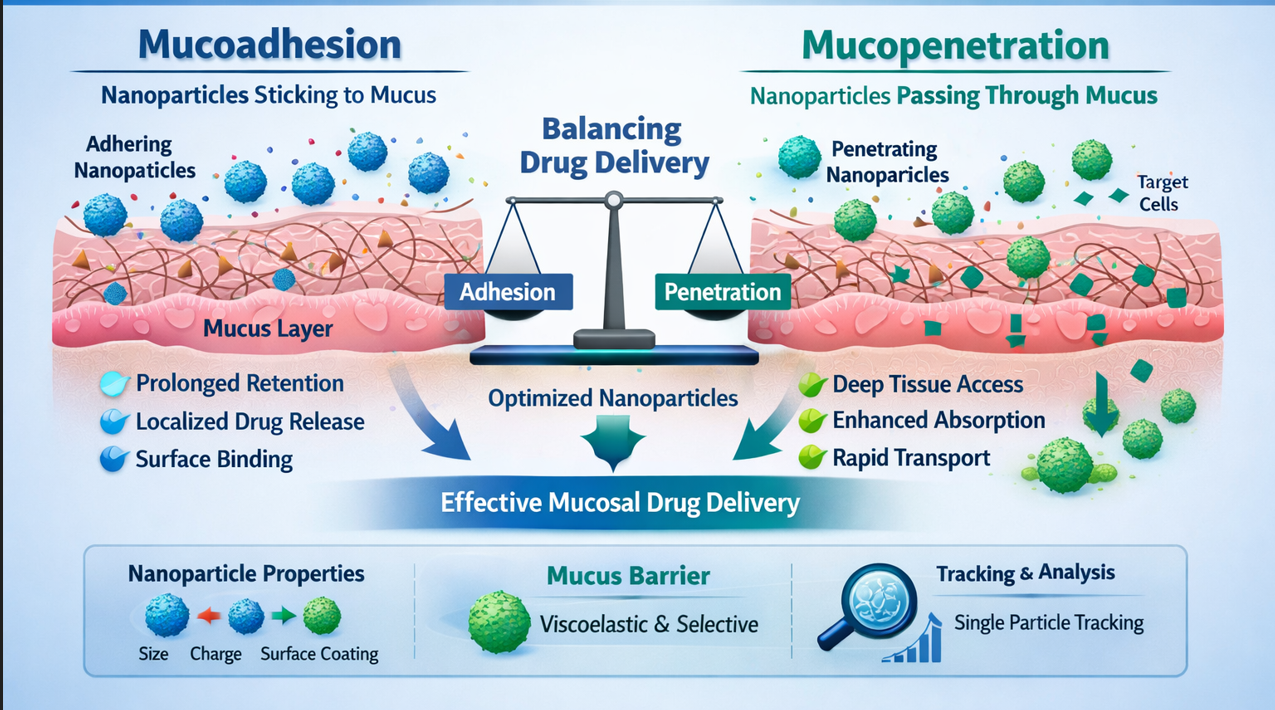
In recent years, mucosal drug delivery has emerged as a promising approach for localized and systemic treatment. However, its success largely depends on the ability of nanoparticles to either adhere to or penetrate the mucus layer. This brings us to a crucial concept in nanomedicine: mucoadhesion vs mucopenetration.
Understanding the Mucus Barrier
Mucus is a viscoelastic gel primarily composed of mucins, water, salts, and various biological molecules. It lines several parts of the body, including the lungs, stomach, nasal cavity, and reproductive tract. Its main function is to trap pathogens and prevent harmful substances from reaching underlying tissues.
However, this protective mechanism also limits the efficiency of drug delivery systems. Nanoparticles introduced into mucosal environments must navigate a dense and constantly renewing network. The pore size of mucus, along with its chemical composition, determines whether particles can pass through or become trapped.
This is why studying nanoparticles in mucus is critical. Their size, surface charge, and hydrophobicity all influence how they interact with the mucus matrix.
Mucoadhesion vs Mucopenetration: A Critical Balance
One of the most important considerations in mucosal drug delivery is the balance between adhesion and penetration.
Mucoadhesion
Mucoadhesion refers to the ability of nanoparticles to bind to the mucus layer. This interaction can occur through various mechanisms, including electrostatic forces, hydrogen bonding, and physical entanglement with mucin fibers.
Advantages of mucoadhesion include:
- Prolonged residence time at the target site
- Improved localized drug concentration
- Reduced dosing frequency
However, excessive adhesion can be counterproductive. If nanoparticles bind too strongly, they may become immobilized and fail to reach the underlying tissue where the drug is needed.
Mucopenetration
Mucopenetration, on the other hand, describes the ability of nanoparticles to move through the mucus layer and reach epithelial cells. This is particularly important for therapies that require systemic absorption or deep tissue targeting.
Key factors enabling mucopenetration include:
- Small particle size relative to mucus pore structure
- Neutral or slightly negative surface charge
- Hydrophilic surface modifications to reduce interactions with mucins
The challenge lies in optimizing nanoparticles to achieve sufficient penetration without being rapidly cleared by mucus turnover.
Why the Balance Matters
The debate of mucoadhesion vs mucopenetration is not about choosing one over the other, but about achieving the right balance based on the therapeutic goal.
- For localized treatments, such as gastrointestinal infections, mucoadhesion may be preferred.
- For systemic delivery or vaccines, mucopenetration becomes more critical.
Designing nanoparticles that can adapt to these requirements is a key focus in modern nanomedicine.
Factors Influencing Nanoparticle Behavior in Mucus
Understanding how nanoparticles in mucus behave requires careful analysis of several physicochemical properties:
1. Particle Size – Smaller nanoparticles are more likely to pass through the mucus mesh. Typically, particles below 200–500 nm show better penetration capabilities.
2. Surface Charge – Surface charge significantly affects interaction with mucins, which are negatively charged. Positively charged particles tend to exhibit stronger mucoadhesion, while neutral particles are more likely to penetrate.
3. Surface Chemistry – Hydrophilic coatings, such as polyethylene glycol (PEG), can reduce adhesion and enhance mobility within mucus.
4. Environmental Conditions – pH, ionic strength, and mucus composition vary across different parts of the body, influencing nanoparticle behavior.
Analytical Challenges in Mucosal Drug Delivery
Despite advancements in nanotechnology, accurately studying nanoparticle interactions within mucus remains challenging. Traditional bulk measurement techniques often fail to distinguish between adhered and freely diffusing particles.
To address this, advanced analytical methods are required, such as:
- Particle size analysis
- Zeta potential measurement
- High-resolution imaging techniques
- Diffusion and mobility tracking
These tools are essential for evaluating how nanoparticles perform in realistic biological environments.
Role of Advanced Tracking Techniques
One of the most promising approaches for studying nanoparticles in mucus is single-particle tracking. This technique allows researchers to observe the movement of individual particles in real time, providing detailed insights into their diffusion behavior.
By analyzing parameters such as trajectory, velocity, and mean squared displacement, scientists can differentiate between mucoadhesive and mucopenetrative behavior. This level of precision is crucial for optimizing nanoparticle design.
However, the lack of standardized protocols and reference materials remains a limitation. Establishing consistent methodologies will be key to advancing research in this field.
Implications for Drug Delivery Performance
The effectiveness of mucosal drug delivery systems depends on how well nanoparticles can overcome the mucus barrier. Poorly designed particles may be cleared before delivering their payload, resulting in reduced efficacy.
Optimized nanoparticles can:
- Improve drug bioavailability
- Enhance targeted delivery
- Minimize systemic side effects
- Increase patient compliance
This makes the study of mucoadhesion vs mucopenetration not just a theoretical concept, but a practical necessity in drug development.
The Importance of Analytical Expertise
Developing successful nanoparticle-based therapies requires precise characterization and testing. Understanding how particles behave in complex biological environments is not possible without advanced analytical capabilities.
At Hyperion Analytical LLC, we support research and development efforts by providing high-quality nanoparticle characterization services. From particle size distribution to surface charge analysis, our expertise helps ensure that drug delivery systems are optimized for performance.
By combining scientific insight with advanced analytical techniques, researchers can design nanoparticles that effectively navigate mucus barriers and achieve desired therapeutic outcomes.

Dynamic and innovative sales and product marketing manager with proven success in sales and market share growth in the analytical instruments industry. Combining in-depth analysis, marketing strategy, business process optimization, and “outside the box” solutions to launch new products and revitalize ongoing business.
Introduced NanoSight’s Nanoparticle Tracking Analysis (NTA) technique to the market, a new and significantly advanced method for sizing and counting nanomaterials. Building market recognition and acceptance through marketing initiatives, customer contact, and publication of technical articles.