
Nanoparticle Tracking Analysis (NTA) is a technique that visualizes and quantifies nanoparticles in suspension by tracking their Brownian motion. Using laser illumination, high-resolution optical tracking, and algorithmic analysis, NTA delivers real-time, particle-by-particle measurement of size, concentration, and movement – resolving individual particles from 10 to 1000 nanometers, with the practical lower limit dependent on a particle’s refractive index. Unlike ensemble methods, which report a single averaged value for an entire sample, NTA offers single-particle resolution, providing accurate, reliable characterization even for heterogeneous samples where an averaged result would obscure meaningful detail.
How Nanoparticle Tracking Analysis Works
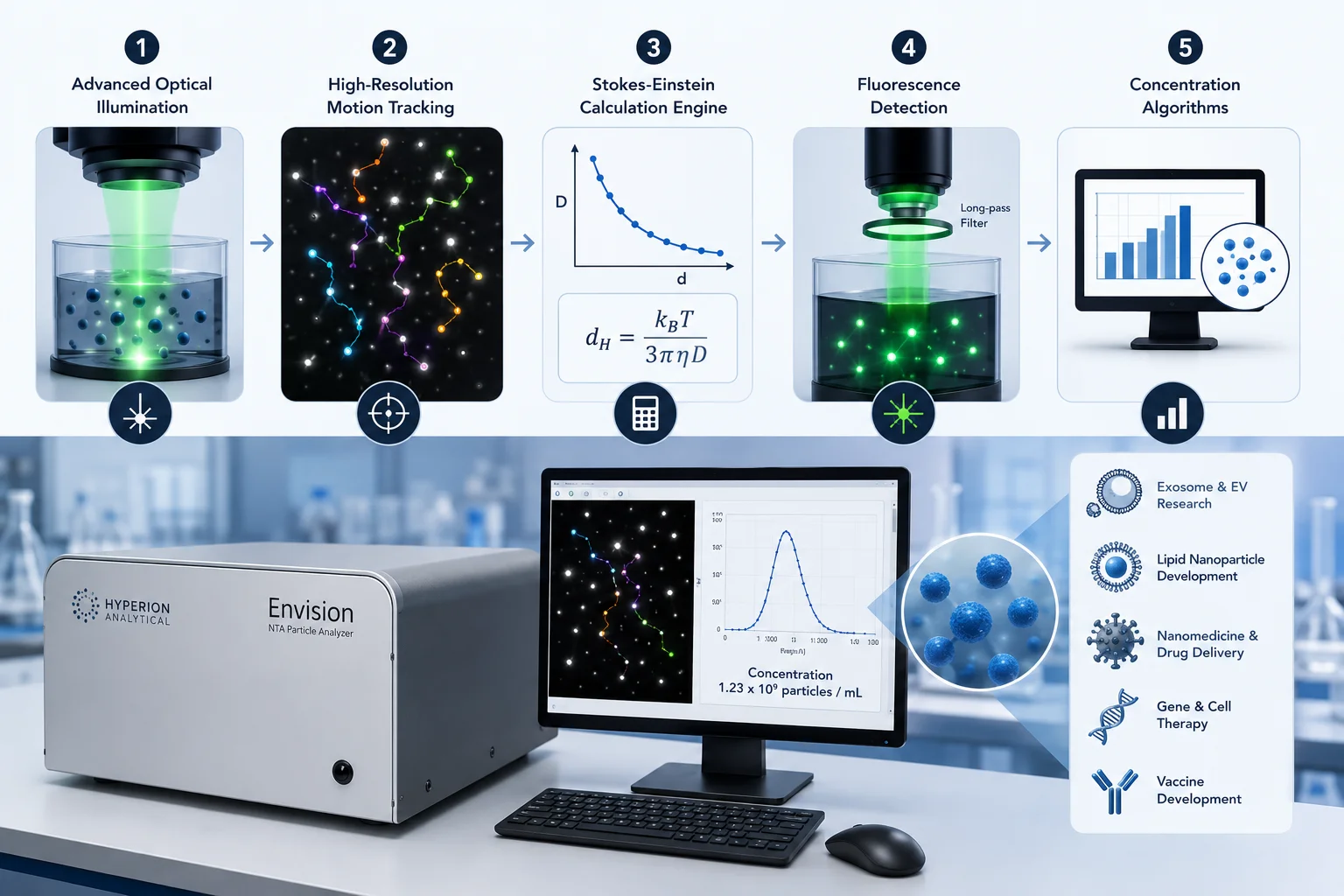
Hyperion Analytical’s Nanoparticle Tracking Analysis (NTA) technology integrates several advanced features, each optimized to deliver precise, reliable, and comprehensive nanoparticle characterization. Our NTA systems are designed to provide unparalleled insight into particle behavior and properties across a wide range of applications. The key components of our NTA technology include:
- Advanced Optical Illumination: A precisely configured laser beam creates optimal scattering conditions for particles suspended in liquid media. The system directly images the light scattered from nanoparticles in suspension, utilizing dark-field illumination. This targeted illumination system generates sufficient signal intensity for accurate tracking while maintaining measurement integrity across the complete size range. As the particles diffuse due to Brownian motion, the speed of their motion directly relates to their size, allowing for precise size characterization.
- High-Resolution Motion Tracking: Ultra-sensitive CMOS cameras capture real-time videos of individual particles undergoing Brownian motion. Each particle’s random thermal motion is precisely tracked through advanced image processing algorithms that extract positional data with nanometer-level precision.
- Stokes-Einstein Calculation Engine: Our Envision NTA Particle Analyzer applies the fundamental Stokes-Einstein equation to convert measured diffusion coefficients into hydrodynamic diameters for each tracked particle. The temperature is also measured, and the appropriate viscosity is used in the calculation. This physics-based calculation ensures measurement accuracy independent of particle composition or optical properties and no calibration is required.
- Fluorescence Detection: Our advanced NTA system incorporates a long-pass optical filter that only allows fluorescent wavelengths to pass through, effectively isolating labeled particles. This enables fluorescence detection for bio-specific identification, providing enhanced analysis capabilities. The calculations remain the same as in scatter mode, ensuring precise measurements that go beyond basic size analysis.
- Concentration Algorithms: Proprietary software calculates absolute particle concentrations through statistical analysis of particle detection rates within the precisely defined measurement volume, delivering quantitative results without requiring calibration standards.
Key Advantages of Nanoparticle Tracking Analysis
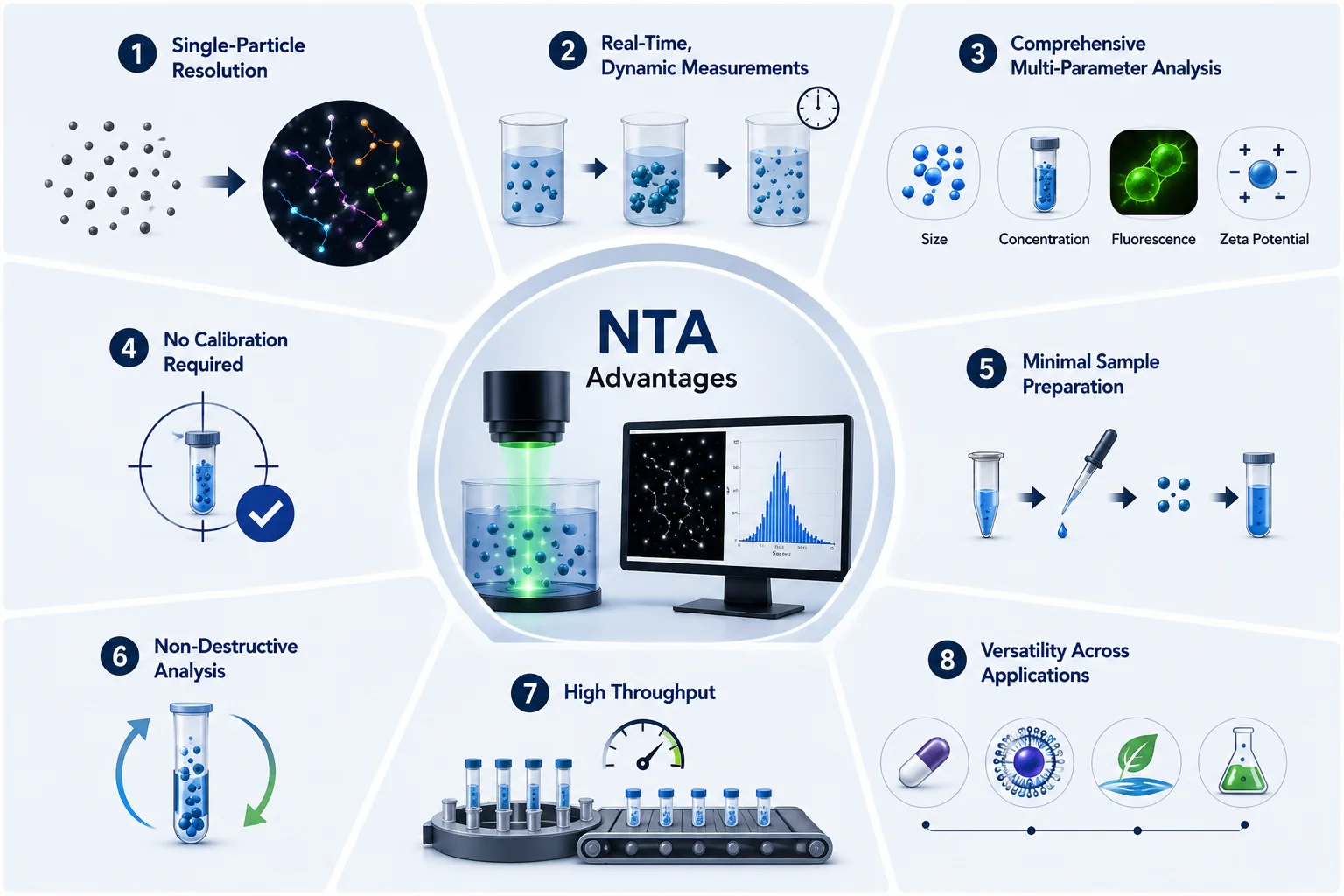
Nanoparticle Tracking Analysis (NTA) offers several advantages that make it the preferred choice for researchers and industries dealing with nanoparticles. Here’s why NTA stands out:
- Single-Particle Resolution: Unlike ensemble methods that provide average measurements, NTA provides single-particle resolution, allowing for the analysis of heterogeneous samples and precise characterization of particle size distributions that are critical for quality control and research applications.
- Real-Time, Dynamic Measurements: NTA captures real-time particle motion, enabling the observation of dynamic processes, such as aggregation (clumping of particles), dissolution (breaking down of particles), and interactions in suspension. This real-time capability helps understand how nanoparticles behave in different environments.
- Comprehensive Multi-Parameter Analysis: NTA enables multi-parameter analysis of nanoparticles in liquid suspension. They help researchers to measure particle sizes, particle concentration, fluorescence intensity, and zeta potential, providing a holistic view of nanoparticle characteristics. This multi-parameter capability offers deeper insights into particle behavior and stability.
- No Calibration Required: NTA operates using absolute methods, meaning no calibration standards are necessary for accurate particle size and concentration measurements. This reduces complexity and ensures reliable results across different sample types.
- Minimal Sample Preparation: NTA requires minimal sample preparation, reducing the risk of sample contamination or alteration. It also needs only small sample volumes, making it ideal for precious or limited samples. Our Envision NTA has a built-in sample pump that ensures consistent, bubble-free sample loading, repeatable flow speeds, as well as easy cleaning cycles through an automated SOP.
- Non-Destructive Analysis: NTA’s non-destructive nature means samples can be analyzed without any significant alteration, allowing for sample recovery and repeated measurements if needed.
- High Throughput: Designed for high-throughput applications, NTA enables efficient analysis of large sample sets while maintaining precision and reproducibility.
- Versatility Across Applications: NTA provides versatility across a wide range of applications, from drug delivery systems and nanoparticle characterization to environmental monitoring and toxicology studies. This versatility makes it an indispensable technology in both academic research and industry settings.
Applications of Nanoparticle Tracking Analysis
Some popular applications of NTA include:
- Extracellular Vesicles (EVs)
- Exosome characterization
- Nanobubbles
- Viruses and Virus-Like Particles
- Nanoparticle Concentration Analysis
- Drug Delivery Nanoparticle Analysis
- Material Sciences
For a closer look at how NTA compares to the other leading particle-sizing technique, see our detailed comparison of NTA vs. DLS. For a full breakdown of NTA alongside SEM/TEM, BET, and zeta potential analysis, visit our Nanoparticle Characterization page.
NTA vs. Dynamic Light Scattering (DLS)
DLS is the other widely used technique for nanoparticle sizing, and the two are often compared directly. In brief:
| NTA | DLS | |
|---|---|---|
| Measurement approach | Individual particle tracking | Ensemble average across the sample |
| Best suited to | Heterogeneous / polydisperse samples | Monodisperse or narrowly distributed samples |
| Concentration data | Direct particle counting | Not directly measured |
| Sensitivity to aggregates | Aggregates identified as a distinct subpopulation | Large particles/aggregates can dominate and skew the signal |
This is a brief overview. For the full technical breakdown, including specific measurement principles, limitations, and application guidance, see our dedicated
NTA vs. DLS comparison.
NTA vs. TEM vs. SEM
Electron microscopy techniques, Transmission Electron Microscopy (TEM) and Scanning Electron Microscopy (SEM), are often used alongside or instead of NTA, depending on what a study requires.
| NTA | TEM | SEM | |
|---|---|---|---|
| What it shows | Size, concentration, and motion in liquid suspension | Internal structure and morphology (2D projection) | Surface topography (3D-like imaging) |
| Sample state | Liquid suspension, near-native conditions | Dried, fixed, under high vacuum | Dried, fixed, under high vacuum |
| Resolution | ~10–1000 nm (particle-by-particle) | Sub-nanometer to atomic scale | Nanometer scale |
| Concentration data | Yes, direct particle counting | No | No |
| Throughput | High, automated, minutes per sample | Low, manual imaging and analysis | Low, manual imaging and analysis |
| Sample prep risk | Minimal, measured in native liquid state | Higher, vacuum and fixation can introduce artifacts | Higher, vacuum and fixation can introduce artifacts |
| Best suited to | Routine sizing, concentration, QC, dynamic processes | Definitive structural/morphological confirmation | Surface structure confirmation |
In practice, many laboratories use NTA for routine, high-throughput sizing and concentration measurements, while reserving TEM or SEM for applications requiring definitive visual confirmation of particle structure or morphology. These techniques are often complementary rather than competing. Learn more about nanoparticle characterization methods.
Choosing the Right NTA Instrument
Selecting an NTA instrument for your application depends on several key factors, independent of any specific vendor:
- Detection sensitivity and lower size limit — varies by instrument and by the refractive index of the material being measured; ask for demonstrated data on materials similar to your own samples, not just a headline number
- Dynamic range — the instrument’s ability to measure both dilute and highly concentrated samples without requiring extensive dilution trials
- Sample volume requirements — important when working with limited or precious samples
- Fluorescence mode capability — necessary for labeled-population studies, and worth checking for photobleaching resistance if extended observation time matters to your work
- Calibration requirements — instruments using absolute, physics-based measurement (like the Stokes-Einstein approach) avoid the added uncertainty of calibration-dependent methods
- Throughput and automation — relevant for labs screening multiple samples or formulations regularly
- Regulatory and standards compliance — for pharmaceutical and regulated environments, confirm alignment with relevant standards such as ISO 19430 and ASTM E2834
For a closer look at how Hyperion Analytical’s Envision NTA addresses each of these factors, see our Nanoparticle Size Analyzer page.
Transform Your Research with Advanced Nanoparticle Tracking Analysis
Hyperion Analytical combines advanced NTA technology with decades of hands-on analytical expertise to solve your toughest nanoparticle characterization challenges. Talk to a scientist today and take the first step toward more precise, reproducible particle data.
Frequently Asked Questions
What is Nanoparticle Tracking Analysis (NTA) used for?
NTA is used to measure the size, concentration, and behavior of nanoparticles in liquid suspension. Common applications include extracellular vesicle and exosome research, drug delivery and lipid nanoparticle formulation, virus and vaccine research, and general nanomaterial characterization.
How accurate is Nanoparticle Tracking Analysis?
NTA uses a physics-based calculation (the Stokes-Einstein equation) that requires no calibration standards, producing accuracy independent of particle composition. Accuracy depends on proper sample concentration, temperature control, and instrument optics — well-maintained systems produce highly reproducible results across operators and sessions.
What size range can NTA measure?
NTA typically resolves particles from approximately 10 to 1000 nanometers. The practical lower limit depends on a particle’s refractive index; lower-refractive-index materials such as polystyrene latex have been measured down to approximately 30 nm.
Does NTA measure particle concentration as well as size?
Yes. NTA calculates absolute particle concentration by counting individually tracked particles within a precisely known measurement volume a direct measurement, not an estimate derived from scattering intensity.
What types of samples can be analyzed with NTA?
NTA can analyze a wide range of nanoparticle types in liquid suspension, including extracellular vesicles, exosomes, viruses and virus-like particles, liposomes, lipid nanoparticles, polymer nanoparticles, and other engineered nanomaterials.
Does NTA require sample calibration?
No. NTA’s physics-based measurement approach does not require calibration standards, which simplifies workflows and reduces a common source of measurement uncertainty found in indirect or ensemble-based sizing techniques.
Can NTA distinguish between different particle populations in a mixed sample?
Yes. NTA reports total particle concentration across a sample, but researchers can apply size filters to separate populations by diameter. In fluorescence mode, only labeled particles are counted, allowing a specific population to be measured even within a complex mixed or biological sample.
How long does an NTA measurement take?
A typical NTA measurement analyzes around 1,000 particles in about one minute, though total time including sample loading and system stabilization is usually a few minutes per sample.
Is NTA non-destructive?
Yes. Because NTA measures particles optically in their native liquid suspension without fixation or labeling requirements (unless fluorescence mode is used), samples can typically be recovered and re-measured if needed.
What’s the difference between NTA and electron microscopy (TEM/SEM)?
NTA measures particles in liquid suspension, providing size, concentration, and motion data with high throughput and minimal sample preparation. TEM and SEM provide direct visual/structural confirmation at higher resolution but require dried, fixed samples under vacuum, which can introduce preparation artifacts and offer no concentration data. See the comparison table above for a full breakdown.
Can NTA be used for quality control in manufacturing?
Yes. NTA’s reproducibility, calibration-free operation, and ability to detect both size and concentration shifts make it well suited to batch-to-batch consistency monitoring and regulatory-facing quality control workflows.