
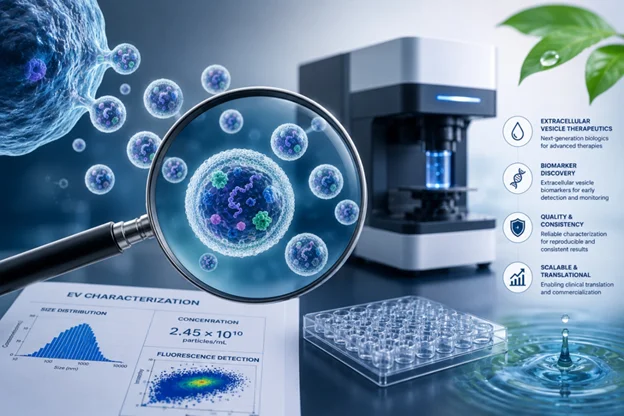
The field of extracellular vesicle research has experienced remarkable growth over the past decade, driven by the increasing recognition of extracellular vesicles (EVs) as powerful tools for diagnostics, drug delivery, and regenerative medicine. As scientific understanding advances, researchers are exploring the immense potential of therapeutic extracellular vesicles and their role in next-generation healthcare solutions.
From cell-to-cell communication to targeted drug delivery, extracellular vesicles offer unique biological advantages that make them attractive candidates for therapeutic applications. However, despite their promise, one major obstacle remains: accurate characterization. The analytical challenges associated with extracellular vesicle therapeutics continue to present significant hurdles for researchers, manufacturers, and regulatory agencies. Understanding these challenges is essential for ensuring product consistency, safety, efficacy, and successful clinical translation.
Understanding Extracellular Vesicle Therapeutics
Extracellular vesicles are naturally occurring membrane-bound particles released by cells into their surrounding environment. These vesicles carry proteins, lipids, RNA, DNA fragments, and other bioactive molecules that influence cellular communication and biological processes.
Due to their natural ability to transport biological cargo, therapeutic extracellular vesicles are being investigated for applications such as:
- Targeted drug delivery
- Regenerative medicine
- Cancer therapy
- Gene therapy
- Immunotherapy
- Neurological disease treatment
- Tissue repair and wound healing
Researchers are also exploring the use of extracellular vesicle biomarkers to improve disease detection, patient monitoring, and personalized medicine strategies. While the therapeutic potential is substantial, the complexity of extracellular vesicles creates significant analytical challenges that must be addressed before widespread clinical adoption can occur.
Challenge 1: Heterogeneity of Extracellular Vesicles
One of the most significant challenges in extracellular vesicle characterization is heterogeneity.
Unlike synthetic nanoparticles, extracellular vesicles are biologically derived and can vary significantly in:
- Size
- Composition
- Surface markers
- Cargo content
- Biological function
- Cellular origin
Even vesicles isolated from the same cell type may exhibit substantial variability.
This heterogeneity complicates efforts to establish standardized characterization methods and quality control protocols. Researchers often encounter multiple subpopulations within a single sample, making it difficult to determine which vesicles contribute to therapeutic activity.
Accurate identification and characterization of these diverse populations are essential for understanding product performance and ensuring reproducible therapeutic outcomes. The Envision optical system provides a low noise image allowing accurate characterization of a wide range of sizes in one sample, something other optical systems struggle to do reliably.
Challenge 2: Accurate Extracellular Vesicle Quantification
Reliable extracellular vesicle quantification remains one of the most important yet challenging aspects of EV research.
Therapeutic development requires precise measurement of vesicle concentration to support:
- Dose determination
- Process optimization
- Batch consistency
- Stability studies
- Clinical trial design
However, extracellular vesicles often exist within complex biological matrices that contain proteins, lipoproteins, cellular debris, and other contaminants. These components can interfere with quantification methods and produce inaccurate results.
Variability in isolation techniques further contributes to inconsistencies between laboratories, making standardization difficult across the industry.
As therapeutic extracellular vesicles move closer to commercialization, robust and reproducible quantification methods will become increasingly important for regulatory approval and manufacturing success. The precisely defined illumination beam of the Envision yields a repeatable and absolute volume from which to measure and report particle concentrations, in contrast to other systems with poor control of beam profile that poorly reproduce from instrument to instrument or even laser to laser on the same instrument.
Challenge 3: Distinguishing Extracellular Vesicles from Contaminants
Another major analytical challenge involves separating genuine extracellular vesicles from non-vesicular particles.
Biological samples frequently contain:
- Protein aggregates
- Lipoproteins
- Cell debris
- Nanoparticles
- Soluble proteins
Many of these contaminants share similar size ranges with extracellular vesicles, making differentiation extremely difficult.
Without appropriate analytical methods, contaminants may be incorrectly identified as EVs, leading to inaccurate characterization data and potentially misleading conclusions regarding therapeutic efficacy. A thorough sample preparation and purification protocol must be established and validated to ensure only the particles of interest are measured. Alternatively, fluorescent labelling protocols can be developed so that only the labeled particles are measured in a mixture.
Challenge 4: Identifying Relevant Extracellular Vesicle Biomarkers
The discovery of extracellular vesicle biomarkers has generated significant interest across biomedical research.
Extracellular vesicle biomarkers offer potential applications in:
- Early disease detection
- Cancer diagnostics
- Treatment monitoring
- Precision medicine
- Biomarker-guided therapy selection
However, identifying and validating these biomarkers remains challenging.
Extracellular vesicle populations often contain thousands of proteins, nucleic acids, and lipids. Determining which components serve as clinically relevant biomarkers requires extensive analytical investigation.
Additionally, variations in isolation methods, sample preparation protocols, and analytical techniques can influence biomarker detection and reproducibility. An antibody-mediated fluorescent labelling protocol will allow marker-specific EV measurements when fully validated. The Envision sensitivity and stability makes this much more robust and reliable.
As biomarker research expands, reliable characterization methodologies will play a critical role in supporting clinical validation efforts.
Challenge 5: Measuring Potency and Therapeutic Function
Unlike traditional pharmaceuticals, extracellular vesicles derive their therapeutic effects from complex biological interactions.
Measuring the potency of exosome therapeutics and other EV-based products presents unique challenges because therapeutic activity may depend on multiple variables, including:
- Cargo composition
- Surface proteins
- Vesicle concentration
- Cellular source
- Biological environment
Currently, no universally accepted potency assay exists for therapeutic extracellular vesicles.
Researchers must therefore develop analytical strategies capable of linking physical characterization data with biological functionality. Achieving this correlation remains one of the most important objectives in the development of EV-based therapeutics.
Challenge 6: Manufacturing Scale-Up and Batch Consistency
As extracellular vesicle therapies advance toward commercialization, manufacturing scalability becomes increasingly important.
Producing therapeutic extracellular vesicles at commercial scale introduces additional analytical challenges related to:
- Process control
- Product consistency
- Stability monitoring
- Quality assurance
- Batch release testing
Small variations during manufacturing can affect vesicle size distribution, concentration, cargo composition, and therapeutic performance.
Consequently, developers require highly reproducible characterization methods capable of supporting quality control throughout the manufacturing lifecycle.
Reliable analytical workflows help manufacturers identify process deviations early and maintain product consistency across multiple production batches. The Envision’s robust and precise optical system provides a strong foundation for reproducible, and therefore comparable, results across multiple operators, sites, or instruments.
Regulatory Expectations Continue to Grow
Regulatory agencies worldwide are paying closer attention to advanced biological therapies, including extracellular vesicle-based products.
To demonstrate safety and efficacy, developers must provide comprehensive characterization data that addresses:
- Particle identity
- Purity
- Size distribution
- Concentration
- Stability
- Biological activity
The absence of standardized characterization frameworks remains a challenge for both regulators and product developers.
As the field matures, analytical rigor will become increasingly important in supporting regulatory submissions and accelerating clinical adoption.
Emerging Technologies Are Helping Address These Challenges
The growing complexity of extracellular vesicle therapeutics has driven demand for more advanced analytical technologies.
Modern characterization approaches increasingly focus on:
- Single-particle analysis
- High-resolution sizing
- Particle concentration measurement
- Fluorescence-based detection
- Multiparametric characterization
- Real-time visualization
These techniques provide researchers with deeper insights into EV populations and help overcome limitations associated with traditional bulk measurement methods.
Advanced analytical tools also improve the ability to study heterogeneous samples, monitor manufacturing consistency, and investigate extracellular vesicle biomarkers with greater confidence.
The Future of Extracellular Vesicle Characterization
The future of extracellular vesicle therapeutics depends heavily on the industry’s ability to develop reliable, standardized characterization strategies.
As research progresses, analytical methods will continue evolving to support:
- Clinical translation
- Commercial manufacturing
- Regulatory compliance
- Biomarker discovery
- Therapeutic optimization
Innovations in particle characterization technologies, imaging systems, fluorescence analysis, and data analytics are expected to play a vital role in advancing the field. Organizations that invest in comprehensive characterization workflows today will be better positioned to unlock the full therapeutic potential of extracellular vesicles tomorrow.

Dynamic and innovative sales and product marketing manager with proven success in sales and market share growth in the analytical instruments industry. Combining in-depth analysis, marketing strategy, business process optimization, and “outside the box” solutions to launch new products and revitalize ongoing business.
Introduced NanoSight’s Nanoparticle Tracking Analysis (NTA) technique to the market, a new and significantly advanced method for sizing and counting nanomaterials. Building market recognition and acceptance through marketing initiatives, customer contact, and publication of technical articles.