
A leading extracellular vesicle (EV) research laboratory at the University of North Carolina required reliable detection of nanoparticles below 70 nanometers, a size range that many analytical systems struggle to characterize accurately.
Their research focused on exosomes and viral particles, making the sub-70nm particle population critical to obtaining complete and meaningful data. Previous attempts using competing nanoparticle tracking technologies failed to detect these smaller particles, resulting in incomplete datasets and limited research insights.
Client Profile
Organization: EV Laboratory, University of North Carolina
Location: Durham, North Carolina, USA
Application Area: Exosomes and Viral Particles
Industry: Biomedical Research
Published: June 2026
Key Results
Sub-70nm Particle Detection: Successfully resolved particle populations below 70nm that competing systems failed to detect.
Single Measurement Analysis: All particle subpopulations were identified and characterized from a single measurement run.
Complete Data Recovery: Achieved full particle population visibility compared to no measurable recovery of sub-70nm particles using competing nanoparticle tracking systems.
The Challenge
The research team needed accurate nanoparticle characterization within the sub-70nm range. Their studies relied heavily on identifying and measuring both exosomes and viral particles, many of which fall below 70 nanometers in size.
However, conventional nanoparticle tracking systems struggled to reliably detect particles in this range. As a result, critical particle populations were being missed, creating gaps in the data and limiting the value of the analysis.
Without visibility into the complete particle distribution, the researchers were unable to obtain the comprehensive characterization required for their work.
Comparative Evaluation
During a live demonstration using a mixed sample containing extracellular vesicles and viral particles, a competing nanoparticle tracking system claimed the capability to resolve particles as small as 30nm.
However, when analyzing the sample:
Competing System
- Detected only larger exosome populations around 100nm
- Failed to identify particle populations below 70nm
- Produced incomplete particle distribution data
Advanced Nanoparticle Analysis Approach
- Successfully resolved all particle subpopulations
- Identified particle populations below 70nm
- Generated a complete particle size distribution profile from a single measurement
Results
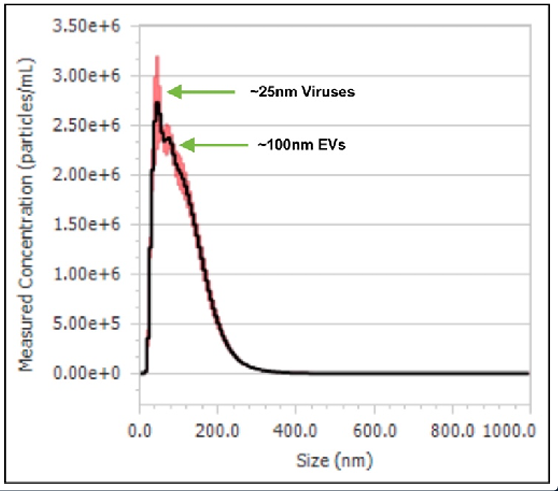
Analysis of the mixed extracellular vesicle and viral particle sample revealed distinct particle populations across the full size range.
The measurement successfully identified:
- Approximately 25nm viral particles
- Approximately 100nm extracellular vesicles
- Additional particle populations throughout the sample
Most importantly, particle populations below 70nm that remained undetected using competing systems were clearly resolved in a single analysis.
As noted by the research team:
“The difference wasn’t incremental. It was the difference between usable data and no data.”
Why This Matters
For researchers working with extracellular vesicles, viral particles, nanomedicine formulations, and advanced biological samples, accurate characterization of small nanoparticles is essential.
Missing particle populations can lead to:
- Incomplete experimental data
- Reduced research accuracy
- Misinterpretation of sample composition
- Challenges in product development and quality control
Reliable nanoparticle analysis enables researchers to gain a more complete understanding of their samples and make informed decisions based on accurate measurements.
Conclusion
This case study demonstrates the importance of accurate nanoparticle characterization, particularly for samples containing particle populations below 70 nanometers.
By resolving previously undetected subpopulations in a single measurement, researchers were able to obtain a complete view of their sample composition and generate actionable data for ongoing studies.
For applications involving extracellular vesicles, viral particles, and other nanoscale materials, comprehensive nanoparticle analysis remains a critical component of successful research and development.

Dynamic and innovative sales and product marketing manager with proven success in sales and market share growth in the analytical instruments industry. Combining in-depth analysis, marketing strategy, business process optimization, and “outside the box” solutions to launch new products and revitalize ongoing business.
Introduced NanoSight’s Nanoparticle Tracking Analysis (NTA) technique to the market, a new and significantly advanced method for sizing and counting nanomaterials. Building market recognition and acceptance through marketing initiatives, customer contact, and publication of technical articles.