
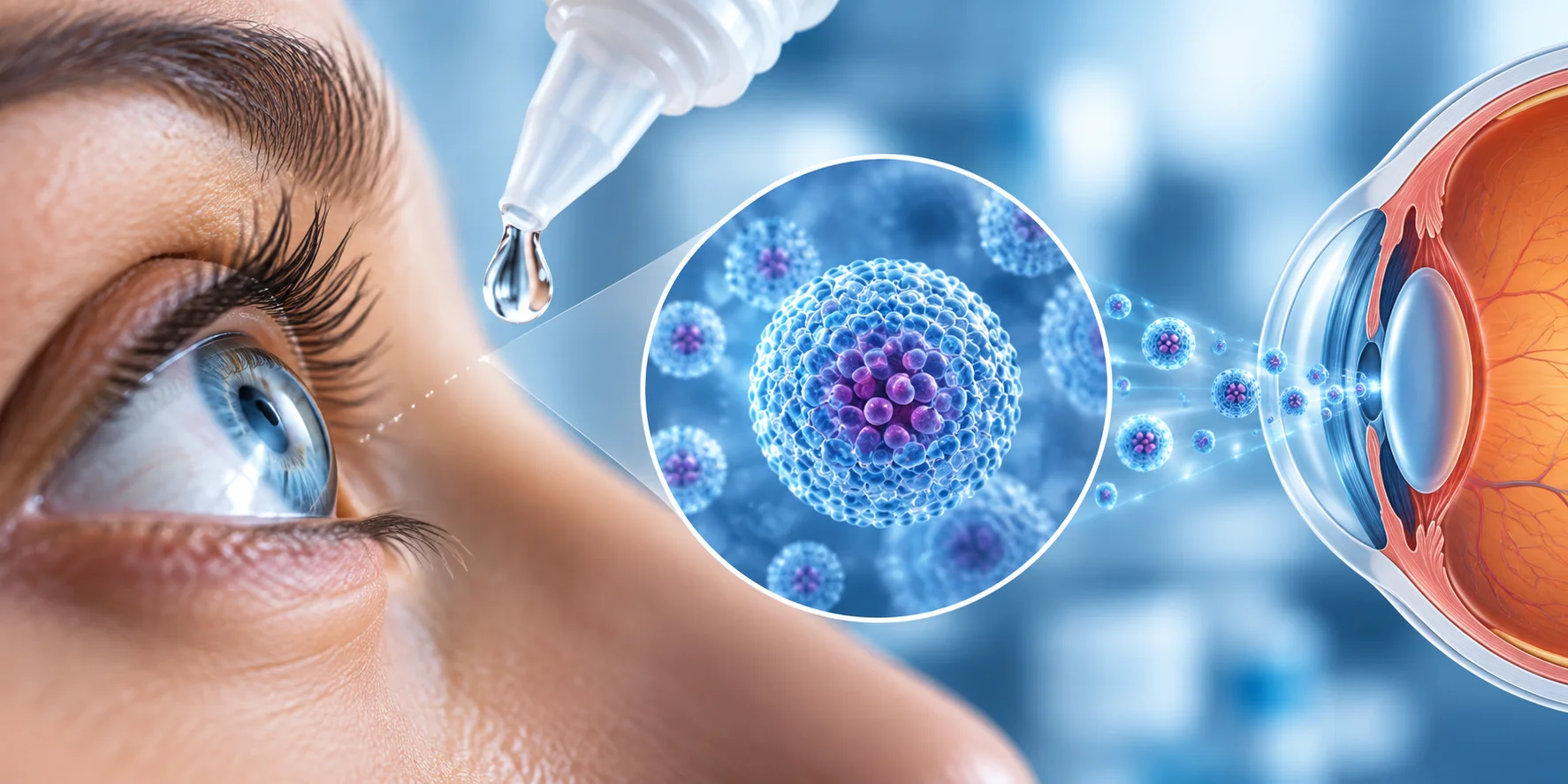
The eye presents one of the most challenging biological environments for drug delivery. Its complex anatomical structure, protective barriers, rapid clearance mechanisms, and delicate physiology significantly limit the effectiveness of conventional therapeutic approaches. While traditional eye drops remain the most common delivery method for ophthalmic treatments, their ability to provide sustained and targeted drug exposure is often limited.
Nanotechnology has emerged as a promising approach to overcome these challenges by enabling the development of nanoparticle-based drug delivery systems capable of improving drug stability, bioavailability, retention time, and targeted delivery.
Nanoparticles including lipid nanoparticles (LNPs), polymeric nanoparticles, liposomes, solid lipid nanoparticles, and extracellular vesicle-based systems are being investigated for applications across ophthalmology, including retinal diseases, glaucoma, corneal disorders, inflammatory conditions, and gene therapy.
However, the successful development of nanoparticle-based ophthalmic formulations depends heavily on accurate characterization. Understanding critical nanoparticle properties such as particle size, concentration, distribution, morphology, and stability is essential for ensuring therapeutic performance, reproducibility, and safety.
Advanced analytical techniques such as Nanoparticle Tracking Analysis (NTA) provide researchers with valuable insights into nanoparticle behavior by enabling direct measurement of particle size distribution and concentration at the individual particle level.
The Role of Nanoparticles in Ophthalmic Drug Delivery
The eye contains multiple barriers designed to protect vision from external threats. These same protective mechanisms create significant challenges for delivering therapeutic molecules.
Important ocular barriers include:
- Tear film turnover
- Corneal epithelial barrier
- Blood-retinal barrier
- Limited drug penetration into ocular tissues
- Rapid elimination through drainage pathways
Nanoparticle delivery systems are designed to address these limitations by improving:
- Drug solubility
- Controlled release
- Tissue penetration
- Cellular uptake
- Therapeutic retention
For example, nanoparticles can protect sensitive molecules such as nucleic acids, proteins, and small-molecule drugs from degradation while improving their delivery to specific ocular tissues.
Lipid nanoparticles have gained particular interest because of their ability to encapsulate therapeutic payloads, including mRNA and gene-editing components. Similarly, extracellular vesicles are being explored as naturally occurring nanocarriers with potential advantages in biocompatibility and targeted cellular communication.
Why Nanoparticle Characterization Is Critical in Ophthalmic Formulations
The biological performance of nanoparticles is strongly influenced by their physical and chemical properties. Small variations in nanoparticle characteristics can significantly affect:
- Drug loading efficiency
- Tissue penetration
- Cellular uptake
- Pharmacokinetics
- Immune response
- Long-term stability
A nanoparticle formulation designed for ocular delivery must demonstrate consistent characteristics throughout development and manufacturing.
Key characterization parameters include:
- Particle size
- Particle concentration
- Size distribution
- Polydispersity
- Morphology
- Surface properties
- Stability over time
Among these parameters, particle size and concentration are particularly important because they directly influence nanoparticle transport, biodistribution, and biological interaction.
Particle Size Analysis in Ophthalmic Nanomedicine
Particle size is one of the most important attributes affecting nanoparticle behavior in ocular environments. Nanoparticles within the appropriate size range may provide advantages such as:
- Improved tissue penetration
- Enhanced cellular uptake
- Longer retention time
- Better drug delivery efficiency
However, particle size must be carefully controlled.
Larger particles may experience:
- Reduced diffusion
- Increased aggregation risk
- Limited tissue penetration
Smaller particles may provide improved penetration but may have different biological interactions and clearance characteristics. Nanoparticle Tracking Analysis enables researchers to measure particle size distributions based on individual particle movement rather than relying only on bulk measurements.
This approach provides valuable information about:
- Mean particle size
- Size distribution profile
- Presence of larger particle populations
- Potential aggregation events
For ophthalmic formulations, understanding the complete size distribution is often more informative than relying only on average particle diameter.
Importance of Particle Concentration Measurement
Particle concentration is another critical parameter in ophthalmic nanoparticle characterization. Concentration measurements provide information about:
- Number of particles delivered per dose
- Formulation consistency
- Manufacturing reproducibility
- Storage stability
For gene therapy and RNA-based ophthalmic treatments, accurate particle concentration measurement is especially important because therapeutic effectiveness depends on delivering a controlled quantity of nanoparticle carriers.
Changes in concentration during storage may indicate:
- Particle degradation
- Aggregation
- Instability
- Loss of nanoparticles during processing
By combining particle concentration measurements with size distribution analysis, researchers can determine whether changes represent true formulation changes or measurement variability.
Nanoparticle Tracking Analysis for Ophthalmic Drug Delivery Research
Nanoparticle Tracking Analysis (NTA) has become an important analytical technique for characterizing nanoscale drug delivery systems. Unlike techniques that measure overall sample properties, NTA analyzes individual particles by tracking their Brownian motion under optical illumination.
This allows researchers to obtain:
- Particle size distribution
- Particle concentration
- Particle population information
For ophthalmic drug delivery applications, NTA can support characterization of:
Lipid Nanoparticles
LNP formulations used for ocular gene delivery require precise control of particle size and concentration to achieve consistent therapeutic performance.
NTA helps evaluate:
- Formulation uniformity
- Storage stability
- Batch-to-batch consistency
Extracellular Vesicles
Extracellular vesicles are being investigated for regenerative medicine and targeted ocular therapies.
NTA enables researchers to evaluate:
- EV concentration
- Size distribution
- Population changes during isolation and storage
Polymeric Nanoparticles
Polymeric systems designed for sustained drug release require characterization to understand:
- Particle stability
- Release behavior
- Formulation optimization
Stability Assessment of Ophthalmic Nanoparticles
Long-term stability is essential for translating nanoparticle formulations into clinical applications. During stability studies, researchers monitor changes in:
- Particle concentration
- Particle size
- Aggregation
- Distribution profile
A stable formulation should maintain consistent nanoparticle characteristics throughout storage. For example, an increase in particle size combined with reduced concentration may indicate aggregation or precipitation.
Conversely, stable concentration and consistent size distribution suggest improved formulation robustness.
Combining NTA with Complementary Characterization Techniques
No single analytical method can fully describe a nanoparticle system. A comprehensive characterization strategy often combines multiple techniques.
Electron Microscopy: Transmission electron microscopy (TEM) provides detailed structural information, allowing researchers to visualize nanoparticle morphology.
Dynamic Light Scattering (DLS): DLS provides hydrodynamic size measurements and is commonly used for bulk particle analysis.
Fluorescence Analysis: Fluorescence-based methods can provide information about specific nanoparticle populations or labeled therapeutic components.
Chemical and Biological Analysis
Additional assays may evaluate:
- Encapsulation efficiency
- Drug loading
- Surface markers
- Biological activity
Combining these approaches provides a more complete understanding of nanoparticle quality and performance.
Regulatory Considerations for Ophthalmic Nanoparticle Development
As nanoparticle-based ophthalmic therapies advance toward clinical applications, regulatory agencies increasingly emphasize detailed characterization of critical quality attributes.
Important considerations include:
- Particle size consistency
- Concentration accuracy
- Manufacturing reproducibility
- Stability data
- Batch characterization
Reliable analytical methods are essential for demonstrating formulation quality and supporting regulatory submissions.
Envision™ NTA Particle Analyzer for Ophthalmic Nanoparticle Characterization
The Envision™ NTA Particle Analyzer from Hyperion Analytical provides researchers with advanced nanoparticle characterization capabilities for complex nanoscale systems.
By enabling accurate measurement of particle concentration and size distribution, Envision supports research applications involving:
- Lipid nanoparticles
- Extracellular vesicles
- Gene delivery systems
- Drug delivery nanoparticles
- Advanced nanomedicine formulations
Accurate nanoparticle characterization allows researchers to better understand formulation behavior, optimize delivery systems, and improve confidence in therapeutic development workflows.

Dynamic and innovative sales and product marketing manager with proven success in sales and market share growth in the analytical instruments industry. Combining in-depth analysis, marketing strategy, business process optimization, and “outside the box” solutions to launch new products and revitalize ongoing business.
Introduced NanoSight’s Nanoparticle Tracking Analysis (NTA) technique to the market, a new and significantly advanced method for sizing and counting nanomaterials. Building market recognition and acceptance through marketing initiatives, customer contact, and publication of technical articles.