
The transition from a controlled benchtop environment to a commercial GMP (Good Manufacturing Practice) facility is often referred to as the “valley of death” in nanomedicine. Scaling a nanotherapeutic, whether a lipid nanoparticle (LNP), polymeric micelle, or extracellular vesicle (EV) platform introduces profound biophysical stressors that can fundamentally alter the drug’s architecture. At the core of a successful technology transfer is the rigorous definition and continuous monitoring of Critical Quality Attributes (CQAs). Proper nanoparticle characterization is not merely an R&D prerequisite; it is the regulatory backbone that dictates whether a scaled-up formulation will secure and maintain clinical approval. Without precise analytical oversight, minor variations in the manufacturing process can cascade into massive batch failures, jeopardizing both capital investments and patient safety.
What Are Critical Quality Attributes in Nanomedicine?
In biopharmaceutical manufacturing, a Critical Quality Attribute (CQA) is defined as a physical, chemical, biological, or microbiological property or characteristic that must be maintained within an appropriate limit, range, or distribution to ensure the desired product quality. In the realm of nanotherapeutics, defining these attributes is uniquely complex because the delivery vehicle is just as critical as the active pharmaceutical ingredient (API) itself.
Primary CQAs for nanomanufacturing include:
- Particle Size and Hydrodynamic Diameter: The physical size of the nanoparticle directly dictates it’s in vivo biodistribution, cellular uptake efficiency, and circulation half-life.
- Size Distribution (Polydispersity): A narrow, monodisperse size distribution ensures that the entire batch behaves predictably. Broad distributions often indicate physical instability or premature degradation.
- Absolute Particle Concentration: Determining the exact number of particles per milliliter is essential for calculating the final therapeutic dosing and evaluating the overall process yield.
- Payload Encapsulation Efficiency: It is vital to verify the ratio of active, payload-loaded nanocarriers to non-functional empty vehicles to ensure the product has the necessary potency.
- Surface Charge (Zeta Potential): The electrostatic potential at the shear plane affects colloidal stability and prevents particles from agglomerating during long-term storage.
The Biophysical Challenges of Scale-Up
As production volumes increase from milliliters to hundreds of liters, the physical forces acting upon the nanoparticles change drastically. Benchtop formulations typically rely on low-volume microfluidic mixers that offer exquisite control over laminar flow and lipid-to-aqueous mixing ratios. However, moving to large-scale turbulent mixing, impinging jet systems, or high-pressure homogenizers introduces intense shear forces.
Furthermore, downstream unit operations present their own hazards. Tangential Flow Filtration (TFF), which is commonly used for continuous solvent exchange and concentration, subjects particles to significant mechanical stress and pressure drops across the filtration membrane. Final sterile filtration processes can inadvertently strip surface coatings or cause larger vesicles to rupture as they are forced through 0.22 µm pores.
These shifts in fluid dynamics and mechanical stress can easily induce structural destabilization, leading to spontaneous aggregation, premature cargo release, or the fusion of distinct particles. If these micro-level biophysical changes are not caught immediately, they can ruin an entire macro-level GMP batch.
Upgrading Legacy Analytical Systems During Tech Transfer
During the scale-up process, biomanufacturing facilities often realize that the bulk-ensemble analytical methods used during early-stage discovery are no longer sufficient for stringent commercial quality control. Relying on a legacy nanoparticle size analyzer powered solely by Dynamic Light Scattering (DLS) introduces significant regulatory and financial risk into the pipeline.
DLS provides an intensity-weighted average of the entire sample in the cuvette. Because light scattering scales with the sixth power of a particle’s radius, even a fractional percentage of large aggregates, a common byproduct of mechanical stress during scale-up and will disproportionately dominate the DLS signal. This phenomenon artificially inflates the reported mean size and completely masks the true monomeric distribution of the target nanoparticles.
To maintain CQAs at commercial scales, biomanufacturing engineers require high-resolution, single-particle data that accurately reflects the formulation’s exact state before and after every single unit operation.
Standardizing SOPs with the Right Hardware
Developing robust Standard Operating Procedures (SOPs) requires reproducible, highly specific analytical workflows that lab technicians can execute consistently across different shifts and global production sites. A reliable particle size analyzer for nanoparticles must integrate seamlessly into these SOPs, providing actionable, operator-independent data without sacrificing analytical sensitivity.
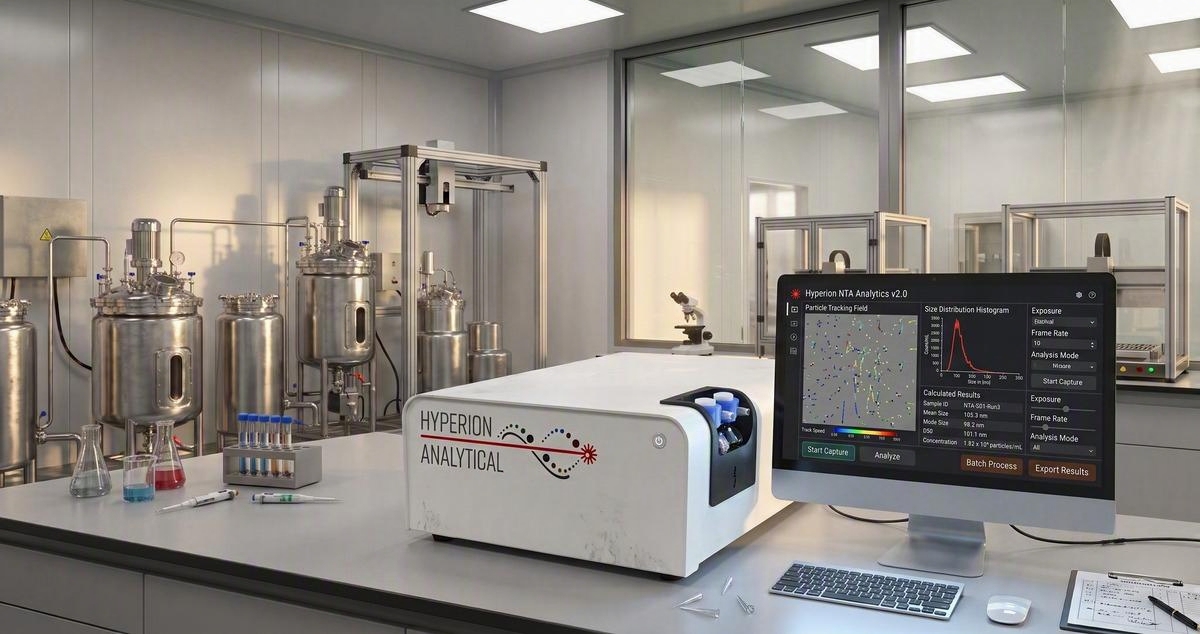
By adopting a modern, high-resolution nanoparticle tracking analysis instrument, manufacturing teams can establish exact baselines for concentration and size. Nanoparticle Tracking Analysis (NTA) physically tracks the Brownian motion of individual particles frame-by-frame. By calculating the diffusion coefficient for each distinct particle, NTA delivers true number-weighted size distributions.
This single-particle resolution is critical for:
- Detecting Trace Aggregates: NTA isolates and quantifies large aggregates without allowing them to overshadow the primary drug product data.
- Monitoring Process Drift: Real-time, high-resolution data allows bioprocessing engineers to spot subtle shifts in size or concentration, enabling them to halt or adjust a process before a batch goes out of specification.
- Validating Tech Transfer: Hardware that provides absolute counting capabilities allows teams to definitively prove that the 100-liter GMP production batch is biophysically identical to the 10-milliliter clinical trial batch.
Ensuring Regulatory Compliance at Commercial Scale
Regulatory bodies like the FDA and EMA expect commercial manufacturers to demonstrate absolute control over their production processes. Implementing the “Quality by Design” (QbD) framework means that quality cannot simply be tested into the final product after the fact; it must be built directly into the manufacturing process itself.
High-resolution single-particle tracking proves to regulatory auditors that the scale-up process is tightly controlled and fully understood. Continuous monitoring of these CQAs through advanced NTA instrumentation accelerates time-to-market, minimizes the financial risk of failed batches, and ultimately ensures that the final nanotherapeutic delivered to the patient is safe, effective, and structurally flawless.

Dynamic and innovative sales and product marketing manager with proven success in sales and market share growth in the analytical instruments industry. Combining in-depth analysis, marketing strategy, business process optimization, and “outside the box” solutions to launch new products and revitalize ongoing business.
Introduced NanoSight’s Nanoparticle Tracking Analysis (NTA) technique to the market, a new and significantly advanced method for sizing and counting nanomaterials. Building market recognition and acceptance through marketing initiatives, customer contact, and publication of technical articles.