
When formulating nanomedicines, isolating extracellular vesicles, or characterizing colloidal suspensions, researchers dedicate immense effort to purifying the particles themselves. However, the suspension medium the buffer is frequently overlooked. In high-resolution analytics, the fluid dynamics of the dispersant are just as critical as the physical properties of the nanoparticles.
Failing to account for buffer composition, pH, and ionic strength is one of the most common sources of error in the laboratory. Even slight environmental variations can induce sudden aggregation, alter particle diffusion rates, and ultimately ruin an otherwise perfect nanoparticle tracking analysis run.
The Foundational Physics of Nanoparticle Tracking Analysis
To understand why buffer composition matters, it is essential to understand how nanoparticle tracking analysis derives its data. The instrument does not measure particle size directly. Instead, it tracks the speed of particles undergoing Brownian motion—the random movement of particles caused by collisions with solvent molecules.
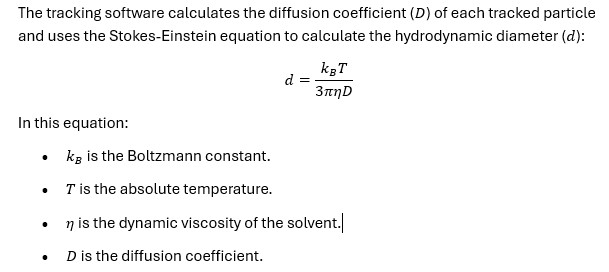
Because T and n are both environmental variables dictated by the buffer and the sample chamber, any inaccuracy in these inputs directly invalidates the resulting data. If you are conducting nano tracking analysis in a highly concentrated sucrose buffer but the software assumes the viscosity of pure water, the particles will move slower than expected, and the system will artificially calculate a much larger particle size.
Ionic Strength and the Electrical Double Layer
Buffer selection goes far beyond simple pH maintenance. The ionic strength of the suspension medium is determined by the concentration of dissolved salts like NaCl, KCl, or phosphate ions in common buffers like PBS has a profound impact on colloidal stability.
Nanoparticles suspended in a liquid are surrounded by an electrical double layer (EDL) of ions. The thickness of this layer is known as the Debye length.
- Low Ionic Strength (e.g., Water or 10 mM HEPES): The Debye length is thick. Particles experience strong electrostatic repulsion (high absolute zeta potential), preventing them from colliding and sticking together. The suspension remains highly stable and monodisperse.
- High Ionic Strength (e.g., 1X PBS or higher): Abundant free ions compress the electrical double layer. The electrostatic repulsion drops, allowing the attractive van der Waals forces to take over.
“When the electrical double layer is compressed by high salt concentrations, previously stable nanoparticles will rapidly collide and permanently fuse, completely altering the sample’s physical profile within minutes.”
When utilizing physiological buffers, the immediate consequence is often rapid, irreversible aggregation directly inside the sample chamber during an nta measurement.
The Impact on Nanoparticle Concentration Measurement
The sudden onset of aggregation due to improper buffer ionic strength does not just skew size distributions; it completely invalidates concentration metrics. Accurate nanoparticle concentration measurement relies on counting every individual monomeric particle in the detection volume.
If a high-salt buffer causes five individual 50 nm lipid nanoparticles to fuse into a single 250 nm cluster, the tracking software will track that cluster as a single distinct entity.
This causes a dual failure in the data:
- Artificial Size Increase: The mean and mode sizes of the distribution will shift dramatically to the right.
- Concentration Collapse: The reported particle concentration will plummet, falsely indicating a massive loss in yield.
For developers calculating therapeutic dosing or validating extraction efficiencies, an inaccurate nanoparticle concentration measurement caused by buffer-induced aggregation can lead to catastrophic miscalculations in downstream workflows.
Troubleshooting Buffer Variables During NTA Measurement
When conducting any nta measurement, establishing a standardized diluent protocol is vital. Complex biological buffers, cryoprotectants (like trehalose or glycerol), and protein-rich mediums naturally alter the refractive index and dynamic viscosity of the sample.
| Buffer Variable | Impact on Analysis | Preventive Strategy |
| High Salt / Ionic Strength | Compresses Debye length, causing rapid particle aggregation. | Dilute the sample in a lower ionic strength buffer (e.g., 10 mM NaCl or HEPES) immediately prior to analysis. |
| High Viscosity Additives | Slows Brownian motion, leading to artificially large size calculations. | Measure the exact kinematic viscosity of the custom buffer and manually input into the tracking software before running. |
| Unfiltered Diluent | Introduces background noise and dust, artificially inflating concentration. | Filter all diluents through a 0.02 µm syringe filter strictly before sample preparation. |
| Temperature Gradients | Alters localized viscosity and induces drift currents in the chamber. | Allow the sample to equilibrate in the instrument block for at least 60 seconds prior to capturing video. |
Best Practices for Reliable Nano Tracking Analysis
To ensure that your data reflects the true state of your nanoparticles rather than an artifact of the suspension medium, adhere to strict buffer management:
- Match the Diluent: Whenever possible, use the exact same buffer for the final NTA dilution as the storage buffer of the original sample to prevent osmotic shock or sudden pH shifts.
- Pre-Filter Everything: Even “ultrapure” commercial PBS contains nanoscale debris. Always pass your diluent through a 0.02 µm filter and run a “blank” measurement to verify the background is clean before introducing your sample.
- Mind the Temperature: Because viscosity is highly temperature-dependent, ensure the Peltier thermal control on your instrument is engaged, calibrated, and given time to equilibrate the fluid within the flow cell.
By treating the buffer as a critical analytical variable rather than just a passive carrier fluid, you can eliminate erratic data, stabilize your colloidal suspensions, and achieve highly reproducible tracking results across all your nanomanufacturing workflows.

Dynamic and innovative sales and product marketing manager with proven success in sales and market share growth in the analytical instruments industry. Combining in-depth analysis, marketing strategy, business process optimization, and “outside the box” solutions to launch new products and revitalize ongoing business.
Introduced NanoSight’s Nanoparticle Tracking Analysis (NTA) technique to the market, a new and significantly advanced method for sizing and counting nanomaterials. Building market recognition and acceptance through marketing initiatives, customer contact, and publication of technical articles.