
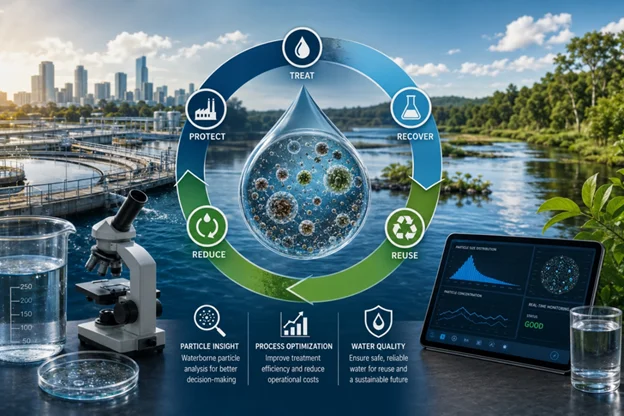
Water scarcity, increasing industrial demand, and growing environmental concerns are driving a global shift toward sustainable water management. As industries and municipalities seek to maximize water resources while minimizing waste, the concept of a circular water economy has emerged as a critical strategy for long-term sustainability.
A circular water economy focuses on reducing water consumption, recovering valuable resources, recycling wastewater, and reusing treated water whenever possible. However, achieving these goals requires more than advanced treatment technologies alone. It also demands a deep understanding of the particles, contaminants, and microscopic materials present throughout the water cycle.
This is where waterborne particle analysis, contaminant particle analysis, and water quality particle characterization play an increasingly important role. By providing detailed insights into particle behavior, distribution, and concentration, particle characterization technologies help organizations optimize water treatment processes, improve water reuse strategies, and support sustainable water management initiatives.
Understanding the Circular Water Economy
Traditional water management systems typically follow a linear model:
- Water extraction
- Water use
- Wastewater generation
- Disposal
In contrast, a circular water economy aims to maximize the value of water resources by keeping water within the system for as long as possible.
This approach emphasizes:
- Water recycling
- Water reuse
- Resource recovery
- Waste reduction
- Sustainable infrastructure
- Environmental protection
Industries ranging from manufacturing and pharmaceuticals to agriculture and municipal utilities are increasingly adopting circular water practices to improve efficiency and meet sustainability goals. However, the success of these initiatives depends heavily on understanding water quality at every stage of the treatment and reuse process.
Why Particle Characterization Matters
Water contains a wide range of particles that can influence treatment efficiency, equipment performance, regulatory compliance, and environmental impact.
These particles may include:
- Suspended solids
- Organic matter
- Microplastics
- Nanoparticles
- Biological contaminants
- Mineral particles
- Industrial residues
- Chemical precipitates
Without proper monitoring, these particles can compromise water treatment performance and reduce the effectiveness of water recycling systems. This makes water quality particle characterization an essential component of modern water management. By analyzing particle size, concentration, distribution, and behavior, organizations can make more informed decisions about filtration, treatment, reuse, and discharge processes.
The Role of Waterborne Particle Analysis in Water Reuse
One of the primary objectives of a circular water economy is increasing water reuse.
Recycled water can be used for:
- Industrial processes
- Cooling systems
- Irrigation
- Manufacturing operations
- Environmental restoration
- Municipal applications
However, successful reuse depends on maintaining consistent water quality standards.
Waterborne particle analysis enables operators to evaluate particle populations throughout treatment processes and identify changes that may affect water quality.
This information helps facilities:
- Optimize filtration systems
- Improve treatment efficiency
- Detect contamination events
- Monitor system performance
- Support regulatory compliance
As water reuse becomes increasingly important worldwide, advanced particle analysis is becoming a critical tool for ensuring water safety and reliability.
Improving Filtration and Treatment Efficiency
Filtration systems are at the heart of most water recycling and treatment operations. Whether using membrane filtration, ultrafiltration, reverse osmosis, or advanced treatment technologies, system performance depends on effective particle removal.
Poor understanding of particle characteristics can lead to:
- Membrane fouling
- Reduced treatment efficiency
- Increased maintenance costs
- Higher energy consumption
- Premature equipment failure
Through water quality particle characterization, operators can gain valuable insights into the particle populations affecting system performance. By understanding particle size distributions and concentration levels, treatment facilities can optimize filtration strategies and improve overall operational efficiency. The Envision NTA system has proven to be a useful tool in monitoring and controlling these tertiary treatment systems. A direct, real time measurement of particle size and concentration can optimize multiple feed parameters including backwash cycle timing.
This contributes directly to the goals of a circular water economy by reducing waste and maximizing resource utilization.
Contaminant Particle Analysis and Water Safety
Protecting water quality is one of the most important aspects of sustainable water management.
Water systems can be exposed to a variety of contaminants, including:
- Industrial pollutants
- Microplastics
- Biological materials
- Chemical residues
- Nanomaterials
- Sediment particles
Many of these contaminants exist at extremely low concentrations and may be difficult to detect using conventional monitoring methods. Contaminant particle analysis provides a more detailed understanding of these materials and their potential impact on water quality.
Advanced analytical techniques help researchers and operators:
- Identify contamination sources
- Monitor treatment effectiveness
- Evaluate environmental risks
- Improve process control
- Enhance public safety
As regulations become more stringent and water quality expectations continue to rise, contaminant particle analysis will play an increasingly important role in sustainable water management. The possibility to be used as a viral clearance check is a promising avenue for further improvements in water treatment safety.
Supporting Wastewater Recycling Initiatives
Wastewater recycling is a cornerstone of circular water economy strategies. Modern treatment facilities are no longer viewed solely as waste processing centers. Instead, they are increasingly recognized as resource recovery facilities capable of generating reusable water and valuable byproducts.
However, successful wastewater recycling requires accurate monitoring throughout the treatment process.
Waterborne particle analysis helps treatment facilities assess:
- Particle removal efficiency
- Treatment performance
- Contaminant reduction
- Water quality consistency
- System optimization opportunities
By continuously monitoring particle characteristics, facilities can improve recycling efficiency while maintaining high-quality water outputs.
This supports both environmental sustainability and long-term water security.
Addressing Emerging Water Challenges
The water industry is facing a growing number of emerging challenges that require more sophisticated monitoring approaches.
These challenges include:
- Microplastic pollution
- Nanoparticle contamination
- Industrial discharge management
- Water scarcity
- Aging infrastructure
- Climate-related impacts
Traditional water quality measurements often provide limited information about these complex issues. In contrast, water quality particle characterization offers detailed insights into particle populations that may otherwise go undetected.
This enhanced visibility helps organizations identify risks earlier and develop more effective mitigation strategies. As water systems become increasingly complex, advanced particle characterization will become even more important for maintaining system resilience and sustainability.
The Value of Real-Time Monitoring
Modern water management increasingly relies on real-time data to support faster decision-making and operational efficiency.
Real-time waterborne particle analysis allows operators to:
- Detect contamination events quickly
- Respond to process changes
- Monitor treatment performance continuously
- Improve predictive maintenance
- Reduce operational downtime
This proactive approach supports more efficient water recycling operations and helps organizations maintain consistent water quality standards. Real-time monitoring also contributes to regulatory compliance by providing continuous documentation of system performance.
Advanced Technologies Are Driving Innovation
Recent advancements in particle characterization technologies have significantly improved the ability to analyze complex water systems.
Modern analytical platforms offer capabilities such as:
- High-resolution particle sizing
- Particle concentration measurement
- Single-particle analysis
- Real-time visualization
- Automated data collection
- Enhanced sensitivity
These innovations are helping researchers and water professionals gain deeper insights into water quality conditions and treatment effectiveness. As analytical technologies continue to evolve, they will play an increasingly important role in supporting circular water economy initiatives around the world.

Dynamic and innovative sales and product marketing manager with proven success in sales and market share growth in the analytical instruments industry. Combining in-depth analysis, marketing strategy, business process optimization, and “outside the box” solutions to launch new products and revitalize ongoing business.
Introduced NanoSight’s Nanoparticle Tracking Analysis (NTA) technique to the market, a new and significantly advanced method for sizing and counting nanomaterials. Building market recognition and acceptance through marketing initiatives, customer contact, and publication of technical articles.