
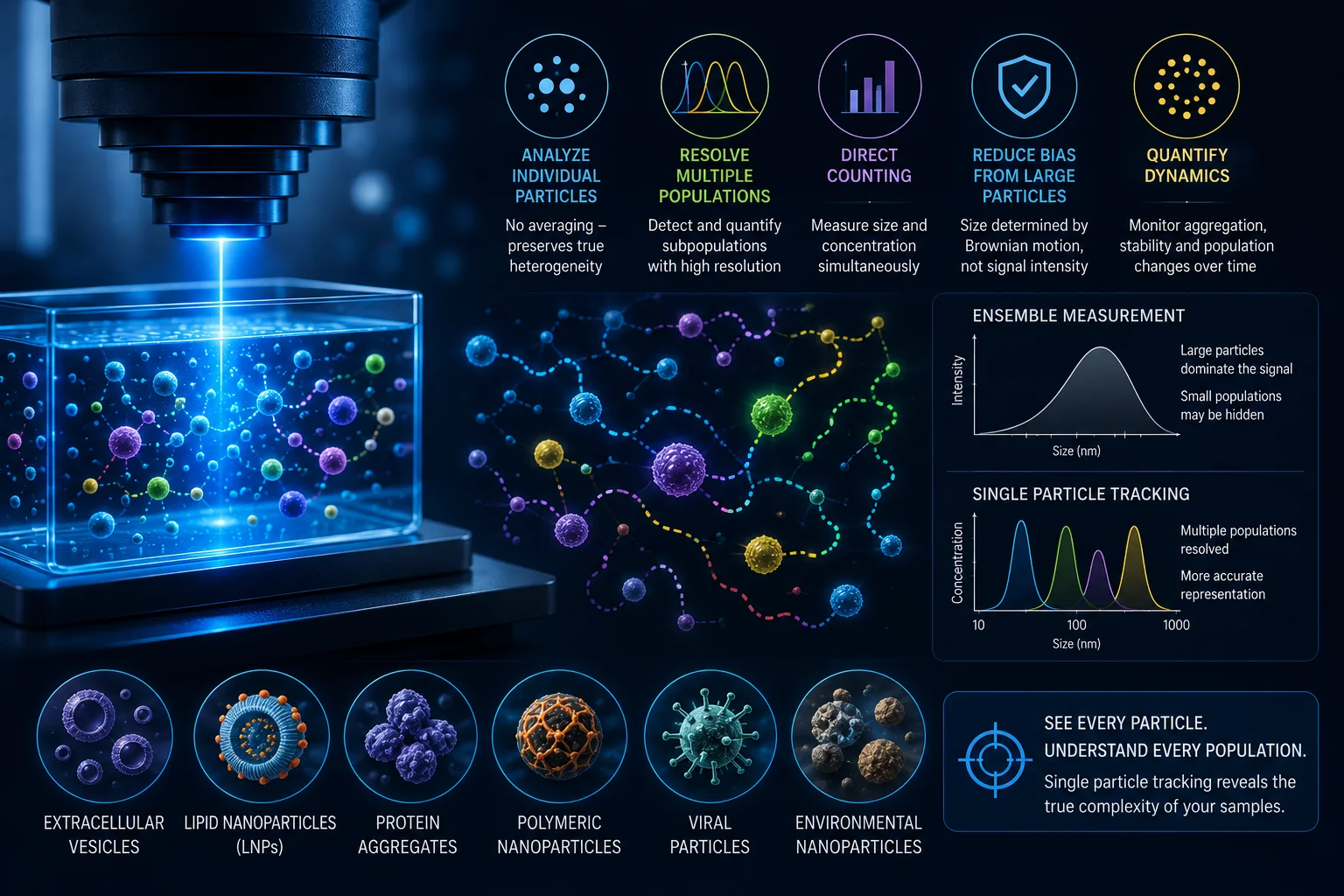
Nanoparticle samples are rarely uniform. In real-world research and industrial applications, nanoparticle suspensions often contain complex mixtures of particles differing in size, composition, morphology, concentration, and optical properties. These heterogeneous populations present significant analytical challenges, particularly when accurate characterization is required for biological, pharmaceutical, or materials science applications.
Traditional ensemble measurement techniques frequently struggle to resolve these complexities because they average signals across the entire particle population. As a result, important subpopulations may be masked, small particle fractions may become underrepresented, and multimodal distributions may appear artificially simplified.
Single particle tracking methods such as Nanoparticle Tracking Analysis (NTA) offer a fundamentally different approach by analyzing particles individually rather than collectively. This capability makes single particle tracking particularly valuable for quantifying heterogeneous nanoparticle populations where accurate resolution of multiple particle populations is essential.
Understanding Nanoparticle Heterogeneity
Nanoparticle heterogeneity refers to variability within a particle population. This variability may include differences in:
- Particle size
- Shape and morphology
- Surface chemistry
- Refractive index
- Aggregation state
- Fluorescence properties
- Particle concentration
Heterogeneity is common across many nanoparticle applications, including:
- Extracellular vesicles (EVs)
- Lipid nanoparticles (LNPs)
- Drug delivery systems
- Protein aggregates
- Polymeric nanoparticles
- Viral particles
- Environmental nanoparticles
In many cases, heterogeneity is not simply experimental noise but rather an important biological or physicochemical property of the sample itself.
For example, extracellular vesicle samples often contain:
- exosomes
- microvesicles
- protein aggregates
- lipoproteins
- cellular debris
Similarly, lipid nanoparticle formulations used in mRNA delivery may contain:
- empty particles
- partially loaded particles
- aggregated particles
- oversized particles
- fragmented particles
Accurate characterization therefore requires methods capable of resolving complex and multimodal particle populations.
Limitations of Ensemble Measurement Techniques
Many conventional nanoparticle characterization methods operate using ensemble measurements. These approaches measure collective scattering or signal behavior averaged across the entire particle population. While ensemble techniques can provide rapid measurements, they often struggle when analyzing heterogeneous systems.
One major limitation arises from intensity weighting effects. Larger particles scatter disproportionately more light than smaller particles. In techniques such as Dynamic Light Scattering (DLS), a small number of large particles or aggregates can dominate the measured signal.
For particles within the Rayleigh scattering regime, scattering intensity scales approximately with the sixth power of particle diameter:
I∝d^6
This means that even a small fraction of larger particles may overwhelm contributions from smaller particle populations.
As a result:
- multimodal distributions may appear as broad single peaks
- small particle populations may become hidden
- aggregates may dominate measurements
- true sample heterogeneity may be underestimated
These limitations become especially problematic in biologically complex nanoparticle systems.
Principles of Single Particle Tracking
Single particle tracking methods overcome many ensemble measurement limitations by analyzing particles individually. In Nanoparticle Tracking Analysis, particles suspended in liquid are illuminated by a laser and visualized using a sensitive camera. Each visible particle is tracked independently as it undergoes Brownian motion.
Particle size is determined by measuring the diffusion behavior of individual particles using the Stokes-Einstein relationship:
D=(k_B T)/6πηr
Where:
- D = diffusion coefficient
- k_B = Boltzmann constant
- T = absolute temperature
- η = fluid viscosity
- r = particle radius
Because each particle is analyzed independently, single particle tracking preserves information about population heterogeneity rather than averaging it away.
Advantages for Heterogeneous Sample Analysis
Single particle tracking offers several important advantages when quantifying heterogeneous nanoparticle populations.
Improved Resolution of Multimodal Distributions
One of the most significant strengths of single particle analysis is the ability to resolve multiple particle populations within a single sample.
For example, a sample containing:
- 60 nm particles
- 120 nm particles
- 250 nm aggregates
may appear as a single broad peak in ensemble measurements. Single particle tracking, however, can often distinguish these populations individually.
This improved resolution is particularly important in:
- extracellular vesicle analysis
- aggregation studies
- formulation optimization
- stability testing
Reduced Bias from Large Particles
Ensemble methods are highly sensitive to large particles because of intensity-weighted signal contributions. Single particle tracking minimizes this bias by measuring diffusion behavior individually rather than relying solely on total scattering intensity.
Although larger particles remain optically brighter, they do not dominate the sizing calculation in the same manner as ensemble approaches.
This enables more representative characterization of heterogeneous samples containing broad size distributions.
Direct Particle Counting
Single particle tracking also enables direct concentration measurement by counting individual detectable particles within a defined imaging volume.
This provides valuable information beyond size alone, including:
- particle concentration
- particle count changes over time
- aggregation kinetics
- stability behavior
For heterogeneous samples, concentration analysis of specific size ranges can provide important insight into population dynamics.
Applications in Biological Nanoparticle Research
The ability to resolve heterogeneous nanoparticle populations is especially important in biological research.
Extracellular Vesicle Characterization
Extracellular vesicle samples are inherently heterogeneous. EV preparations often contain multiple vesicle subtypes alongside contaminants and aggregates.
Single particle tracking allows researchers to:
- characterize broad EV distributions
- monitor isolation quality
- detect aggregation
- evaluate storage stability
- compare preparation methods
This is particularly important because subtle changes in EV population structure may influence biological function and therapeutic activity.
Lipid Nanoparticle Formulation Analysis
Lipid nanoparticles used for nucleic acid delivery require tight control over particle size distribution and aggregation state.
Heterogeneous LNP populations may affect:
- encapsulation efficiency
- biodistribution
- cellular uptake
- therapeutic efficacy
- formulation stability
Single particle tracking enables detection of:
- oversized particles
- aggregates
- instability-induced population shifts
- concentration changes during storage
Protein Aggregation Studies
Protein aggregation remains a major challenge in biopharmaceutical development. Small populations of aggregates may influence:
- drug stability
- immunogenicity
- formulation quality
- shelf life
Single particle analysis can improve detection of heterogeneous aggregate populations that may be difficult to resolve using ensemble methods alone.
Challenges in Single Particle Tracking
Although single particle tracking provides major advantages, several analytical challenges remain.
Optical Detection Sensitivity
Particles must scatter sufficient light to be detected reliably. Low-refractive-index nanoparticles may approach the detection limit, especially at small diameters.
This can influence:
- concentration accuracy
- distribution completeness
- detection sensitivity
Sample Concentration Optimization
Particle concentration must remain within an optimal range.
Overly concentrated samples can produce:
- overlapping trajectories
- tracking ambiguity
- inaccurate sizing
Overly dilute samples may reduce statistical robustness.
Careful dilution optimization is therefore essential.
Background Noise and Artifacts
Biological samples frequently contain background contaminants, debris, or non-particle scattering sources that may interfere with tracking accuracy.
Proper sample preparation and instrument optimization are critical for reliable analysis.
Importance of Statistical Interpretation
Quantifying heterogeneous nanoparticle populations requires careful statistical interpretation.
Researchers should consider:
- number-weighted distributions
- concentration distributions
- repeatability across runs
- threshold effects
- detection sensitivity limitations
Because single particle tracking measures thousands of individual particles, statistical robustness improves with adequate sampling and proper experimental controls.
Replicate measurements and standardized workflows remain essential for generating reproducible data.
Future Directions in Heterogeneous Nanoparticle Analysis
As nanoparticle systems become increasingly complex, demand for advanced characterization tools will continue growing.
Emerging developments in single particle analysis may include:
- AI-assisted tracking algorithms
- fluorescence subpopulation analysis
- automated population classification
- multimodal imaging integration
- enhanced low-signal detection
- machine learning-based distribution analysis
These technologies will further improve the ability to characterize heterogeneous nanoparticle systems with higher sensitivity and precision.

Dynamic and innovative sales and product marketing manager with proven success in sales and market share growth in the analytical instruments industry. Combining in-depth analysis, marketing strategy, business process optimization, and “outside the box” solutions to launch new products and revitalize ongoing business.
Introduced NanoSight’s Nanoparticle Tracking Analysis (NTA) technique to the market, a new and significantly advanced method for sizing and counting nanomaterials. Building market recognition and acceptance through marketing initiatives, customer contact, and publication of technical articles.