
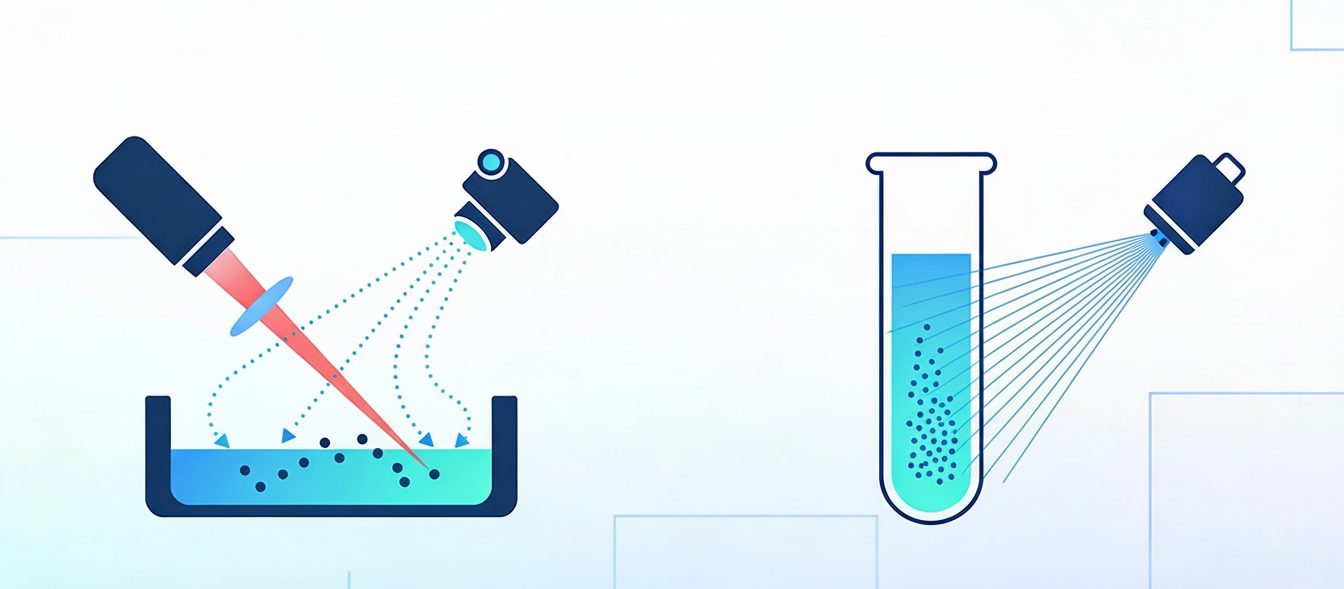
Comparing NTA & DLS
Dynamic Light Scattering (DLS) and Nanoparticle Tracking Analysis (NTA) are widely used techniques for nanoparticle size measurement. Both rely on light scattering nanoparticles in suspension, yet they answer different questions. DLS offers fast ensemble averages, while NTA provides particle-by-particle resolution and direct concentration data. Researchers often use both during formulation and process development. At Hyperion Analytical, we built Envision NTA after years of working with real samples where heterogeneity, aggregates, and low-abundance populations mattered more than a single mean size.
How Each Technique Works: Core Principles and Physical Measurements
Dynamic Light Scattering (DLS)
Dynamic light scattering measures intensity fluctuations from an ensemble of particles simultaneously. When light hits a suspension, particles scatter photons in all directions. These particles move randomly through Brownian motion, causing scattered light intensity to fluctuate over time. The DLS particle size analyzer records these fluctuations with a photodetector positioned at a fixed angle, typically 90 or 173 degrees.
The instrument correlates intensity changes to extract a diffusion coefficient. This coefficient is used to convert to the hydrodynamic diameter using the Stokes-Einstein equation. Measurements are completed quickly, typically in 30 seconds to 2 minutes. The result is typically reported as a z-average diameter and a polydispersity index (PDI).
The z-average represents an intensity-weighted mean. The light-scattering intensity scales with the sixth power of the particle diameter, so larger particles dominate the signal. A small number of aggregates can significantly skew results. This creates challenges when characterizing heterogeneous samples.
DLS offers notable advantages for specific applications. Measurement speed is exceptional. Sample volume requirements are minimal, often just 3 to 12 microliters. The technique extends to very small particles, detecting species as small as 1 nm under optimal conditions. For monodisperse samples with narrow distributions, DLS provides reliable, reproducible size information with excellent precision. This explains why the DLS particle size analyzer remains common in early screening and routine checkups.
However, the intensity-weighted distribution makes quantitative interpretation difficult for complex samples. The polydispersity index indicates distribution width but doesn’t reveal whether multiple populations exist. Concentration measurements require calibration or separate analytical methods.
Nanoparticle Tracking Analysis (NTA)
Nanoparticle tracking analysis operates on a fundamentally different principle. NTA visualizes and tracks individual particles moving in solution as they undergo Brownian motion. The system illuminates particles with a laser under conditions that create a scattered light cone visible to a microscope objective. Each particle appears as a point of light against a dark background.
Video frames capture particle positions at high speed, typically 30 frames per second. Software algorithms identify each particle and track its movement across consecutive frames. From displacement data, the system calculates a diffusion coefficient for every single particle. This coefficient determines the hydrodynamic diameter using the same Stokes-Einstein relationship as DLS. The fundamental difference is measurement philosophy. DLS analyzes the collective behavior of millions of particles simultaneously. NTA examines particles one at a time. This distinction has significant consequences for data quality and interpretation.
When you run an NTA measurement, you see particles moving. This direct visualization offers insights that ensemble methods cannot provide. You observe heterogeneity in real time. Subpopulations become obvious. A formulation containing 95% particles at 80 nm and 5% aggregates at 400 nm displays both populations clearly.
The tracking algorithm follows each particle’s path through the solution. Fast-moving particles are small. Slow-moving particles are large. The software calculates the size of each tracked particle independently. When the analysis completes, you receive a number-weighted size distribution where every particle contributes equally regardless of size. This particle-by-particle approach eliminates intensity-weighting bias inherent in light scattering molecular weight measurements. A 50 nm particle and a 500 nm particle each count as one particle in your distribution. The result is an accurate representation of your sample’s composition.
NTA also measures concentration directly by counting particles in a defined volume. This yields absolute concentration in particles per milliliter without calibration. You get size and concentration from one measurement in about 3 to 5 minutes, with resolution to detect subpopulations separated by 20 to 30 nm. NTA does require appropriate dilution to avoid overlapping trajectories. Practical working concentrations typically range from 10⁷ to 10⁹ particles/mL in the viewing volume.
Selecting the Right Method: Application-Specific Recommendations
Your choice between NTA and a DLS particle size analyzer depends on sample properties and analytical requirements. Here are practical guidelines based on common research scenarios.
Choose NTA When You Need:
- Accurate polydisperse characterization: If your formulation contains multiple size populations, subvisible particles, or aggregates, NTA provides quantitative distributions that reveal true composition. This applies to lipid nanoparticles, liposomes, viral vectors, protein aggregates, and any therapeutic where aggregation monitoring is critical.
- Absolute concentration data: Dose calculations, formulation stoichiometry, and particle number specifications require concentration in particles per milliliter. NTA measures this directly. Applications include cell therapy products, gene delivery vectors, and any formulation where particle dose affects efficacy.
- Quality control for complex formulations: Manufacturing consistency depends on detecting subtle changes in size distribution and aggregate content. NTA’s sensitivity to subpopulations makes it suitable for release testing, stability studies, and process validation. The technique aligns with regulatory expectations for nanomedicine characterization.
- Process development screening: When optimizing lipid ratios, PEG content, or encapsulation methods, NTA’s 3-to-5-minute measurement time allows efficient evaluation of 15 to 25 samples per day. You maintain statistical rigor (thousands of tracked particles) while achieving practical throughput.
Choose DLS When You Need
- Rapid screening of narrow distributions: DLS provides reliable mean diameters quickly for monodisperse samples with polydispersity indices below 0.15. This is suitable for applications where you’re monitoring a single population for changes, such as protein stability studies or polymer synthesis optimization.
- Small particle measurements: Below 30 nm, NTA’s detection limits make measurements unreliable or impossible. DLS characterizes proteins (3 to 10 nm), polymer micelles (10 to 30 nm), and other small species effectively. The technique bridges into the size range where light scattering molecular weight analysis becomes relevant.
- Minimal sample volume: When working with extremely limited material (less than 20 microliters total), DLS’s lower volume requirements become decisive. This applies to precious biologics, early synthetic batches, or samples recovered from microscale reactors.
- High-throughput initial screening: If you need to evaluate 50 or 100 formulations in a day to identify promising candidates, DLS’s speed advantage becomes significant. You can triage samples quickly and then characterize selected formulations more thoroughly with NTA or other techniques.
Complementary Use of Both Techniques
Many research programs benefit from combining both methods.
- Use DLS for rapid screening and NTA for detailed characterization. This approach balances throughput with data quality.
- You identify interesting formulations quickly with DLS, then verify size distributions and measure concentrations with NTA before advancing candidates to in vivo studies or manufacturing scale-up.
- The combination also provides orthogonal validation. If DLS shows a low polydispersity index and NTA confirms a narrow, unimodal distribution, you gain confidence in your formulation’s homogeneity. If the results disagree, as DLS shows apparent monodispersity while NTA reveals aggregates, investigate further before proceeding.
How Envision NTA Addresses Analytical Challenges
The Envision system from Hyperion Analytical specifically targets the needs of pharmaceutical researchers and quality control laboratories working with therapeutic nanoparticles. The instrument combines fundamental advantages of nanoparticle tracking analysis with practical features that simplify routine use.
- Optical Design and Measurement Quality: Optical design determines measurement quality in NTA. Envision uses precisely engineered illumination that maintains stable intensity across the field of view. Background noise remains minimal. This matters when tracking weakly scattering particles, such as lipid nanoparticles or polymer micelles, which might be difficult to visualize with less refined optics.
- Automated Sample Introduction: Sample introduction affects reproducibility. Manual injection can introduce variability from user to user or day to day. Envision includes an integrated syringe pump that controls flow rate automatically. Combined with a sealed flow cell design, this eliminates bubbles and maintains consistent tracking conditions across measurements.
- Measurement Range and Fluorescence Mode: The measurement range spans approximately 30-1000 nm for most particles, encompassing typical therapeutic formulations. Fluorescence mode extends the capability by enabling the specific detection of labeled particles. You can track targeted nanoparticles in complex backgrounds or follow encapsulated cargo through biological media without interference from unlabeled components.
- Simplified Maintenance and Operation: Cleaning requires only a brief rinse. No disassembly. This keeps measurements moving during quality control sessions when you’re characterizing multiple production batches. The system returns to measurement-ready state in minutes rather than requiring an extensive breakdown between samples.
- Intelligent Software Features: Software provides real-time feedback on concentration appropriateness, tracking quality, and measurement progress. This guides users toward optimal results even when they’re relatively new to the technique. Analysis completes automatically once sufficient particles have been tracked, typically 1,000 to 5,000 particles depending on distribution complexity.
Frequently Asked Questions (FAQs)
Can NTA and DLS measure the same samples?
Yes, but each technique provides different information. NTA gives number-weighted distributions while DLS provides intensity-weighted results, making direct comparison challenging for polydisperse samples.
What concentration range works best for NTA measurements?
Optimal concentration in the measurement chamber is 10^7 to 10^9 particles/mL. Envision software provides real-time feedback if concentration requires adjustment.
How does temperature affect particle size measurements?
Temperature directly affects viscosity and diffusion rates. Both NTA and DLS require temperature control during measurement for accurate, reproducible results.
Can NTA distinguish between empty and cargo-loaded nanoparticles?
NTA measures hydrodynamic size based on Brownian motion. Size differences may be detectable if cargo substantially affects diameter, but complementary techniques are needed for encapsulation efficiency.
How do buffer conditions affect NTA measurements?
Buffer viscosity affects diffusion rates and calculated sizes. Most pharmaceutical buffers (PBS, HEPES, citrate, and acetate) work well, but viscosity must be known for accurate size determination.
Is NTA suitable for regulatory submissions?
Yes, NTA’s physics-based measurement principle and particle-by-particle approach align with regulatory expectations for nanomedicine characterization and quality control.
How long does a typical NTA measurement take?
Analysis completes in 3-5 minutes, allowing efficient screening of 15-25 samples per day for formulation development and quality control.
What’s the lower size limit for NTA detection?
For lipid nanoparticles and similar materials, reliable detection typically begins around 30-40 nm, depending on particle refractive index and scattering efficiency.