
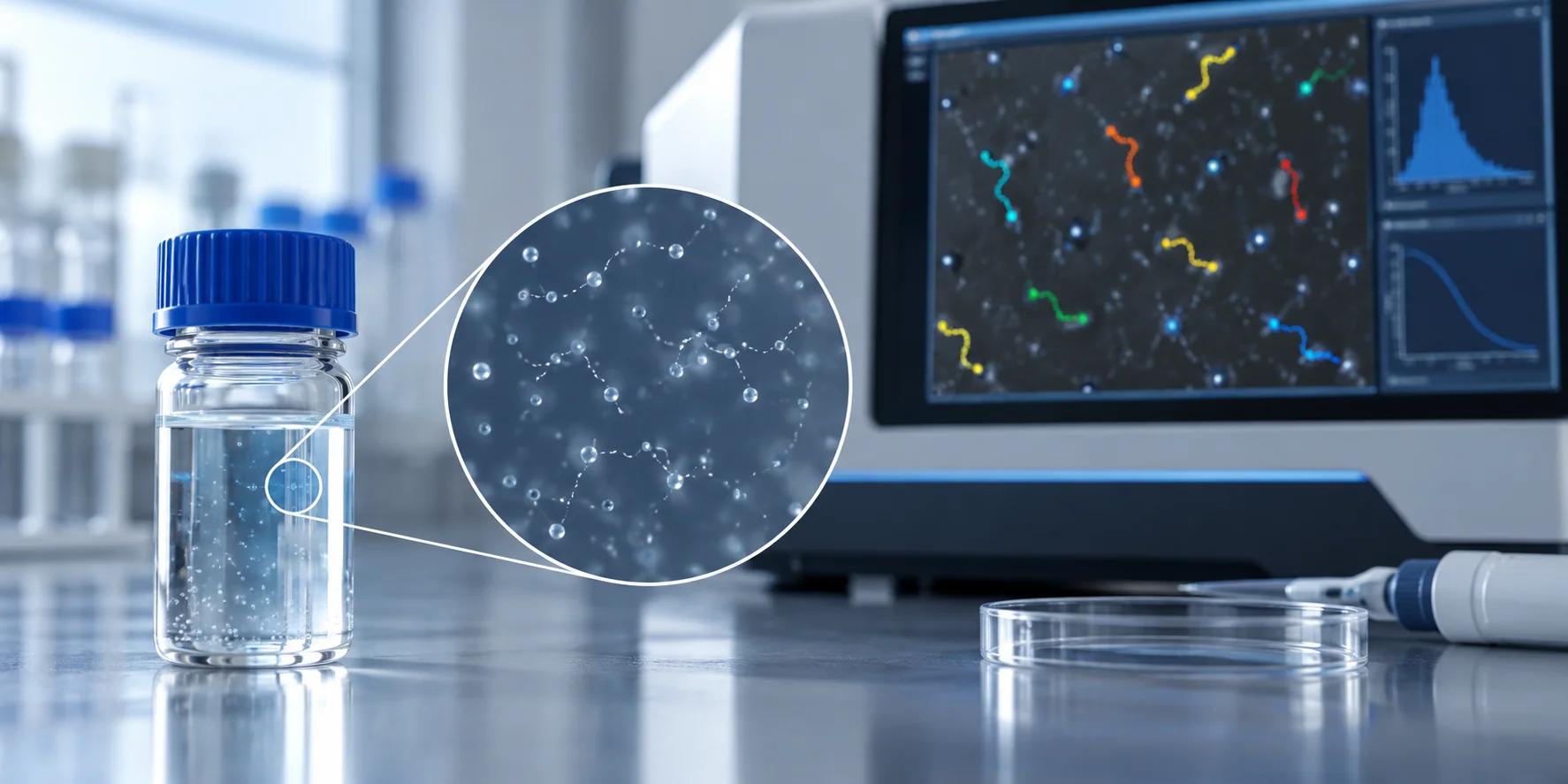
The movement of nanoparticles suspended in a liquid provides valuable information about their physical properties. At the nanoscale, particles are continuously influenced by random collisions with surrounding solvent molecules, causing them to move in unpredictable directions. This phenomenon, known as Brownian motion, forms the foundation of several nanoparticle characterization techniques.
One of the most important parameters used to describe nanoparticle movement is the diffusion coefficient. The diffusion coefficient quantifies how rapidly particles move through a fluid as a result of Brownian motion and provides essential information about nanoparticle size, hydrodynamic behavior, and interactions with their surrounding environment.
In techniques such as Nanoparticle Tracking Analysis (NTA), diffusion coefficients are directly related to particle size measurement. By analyzing individual particle trajectories and calculating their movement behavior, NTA systems can determine nanoparticle size distribution and concentration with high precision.
Understanding diffusion coefficients is particularly important for researchers working with extracellular vesicles (EVs), lipid nanoparticles (LNPs), drug delivery systems, nanobubbles, and engineered nanomaterials, where particle size and behavior directly influence biological performance, formulation stability, and therapeutic effectiveness.
What Is a Diffusion Coefficient?
The diffusion coefficient, commonly represented by the symbol D, describes the rate at which particles diffuse through a medium due to random thermal motion. In simple terms, it indicates how quickly a nanoparticle moves within a liquid environment.
A higher diffusion coefficient means:
- Faster particle movement
- Smaller particle size
- Lower resistance from the surrounding fluid
A lower diffusion coefficient indicates:
- Slower particle movement
- Larger particle size
- Greater interaction with the surrounding medium
The diffusion coefficient is typically expressed in units of:
- Square meters per second (m²/s)
- Square centimeters per second (cm²/s)
At the nanoscale, diffusion coefficients are strongly influenced by particle size, temperature, and solvent properties.
The Relationship Between Diffusion Coefficient and Particle Size
The relationship between diffusion coefficient and nanoparticle size is described by the Stokes-Einstein equation:
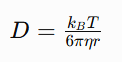
The equation demonstrates that diffusion behavior depends on:
- Temperature of the system
- Viscosity of the surrounding fluid
- Hydrodynamic radius of the particle
According to this relationship, smaller nanoparticles experience faster Brownian motion because they encounter less resistance from the surrounding fluid.
For example:
- A 50 nm nanoparticle will always have a higher diffusion coefficient than a 200 nm nanoparticle under identical conditions.
- Aggregation events that increase particle size will result in slower diffusion.
This relationship allows researchers to calculate nanoparticle size by measuring particle movement.
Brownian Motion and Nanoparticle Tracking Analysis
Nanoparticle Tracking Analysis (NTA) relies on the principle that nanoparticles suspended in a liquid undergo Brownian motion. The movement of each particle is captured through optical microscopy, and the system tracks individual particle trajectories over time.
The diffusion behavior of each particle provides information about:
- Particle size
- Size distribution
- Particle concentration
Unlike bulk measurement approaches, NTA evaluates individual particles, allowing researchers to observe variations within complex nanoparticle populations.
For example, a sample containing extracellular vesicles may include particles with different sizes. By analyzing diffusion coefficients across thousands of particles, NTA can generate a detailed size distribution profile rather than reporting only an average measurement.
Why Diffusion Coefficients Matter in Nanoparticle Characterization
Diffusion coefficients provide valuable insight into nanoparticle properties and behavior.
1. Particle Size Determination
One of the primary applications of diffusion coefficient analysis is determining nanoparticle size. Because diffusion is directly related to hydrodynamic radius, measuring particle movement enables researchers to estimate particle dimensions in solution.
This is especially important for:
- Lipid nanoparticles
- Exosomes
- Viral vectors
- Polymer nanoparticles
- Protein aggregates
Accurate size measurement helps researchers understand whether particles are within the desired range for their intended application.
2. Detecting Aggregation and Stability Changes
Changes in diffusion behavior can provide early indications of nanoparticle instability.
When nanoparticles aggregate:
- Particle size increases
- Diffusion slows
- The diffusion coefficient decreases
Monitoring diffusion coefficients over time allows researchers to evaluate formulation stability during:
- Storage studies
- Freeze-thaw cycles
- Manufacturing processes
- Transport conditions
For pharmaceutical nanoparticles, this information is critical because aggregation can affect drug delivery efficiency, biodistribution, and safety.
3. Understanding Particle Interactions
Nanoparticles do not always behave as isolated particles. They may interact with:
- Proteins
- Other nanoparticles
- Biological molecules
- Solvent components
These interactions can alter particle movement and influence measured diffusion coefficients.
Changes in diffusion behavior may indicate:
- Surface modification effects
- Protein corona formation
- Particle association
- Environmental changes
Factors Affecting Diffusion Coefficient Measurements
Several physical and experimental factors influence diffusion coefficient calculations.
Temperature
Temperature directly affects Brownian motion.
As temperature increases:
- Molecules move faster
- Particle movement increases
- Diffusion coefficients become larger
Therefore, maintaining controlled temperature conditions is essential for accurate nanoparticle measurements.
Fluid Viscosity
The surrounding liquid affects particle movement. Higher viscosity creates more resistance, reducing diffusion.
For example:
- Nanoparticles in water will diffuse differently compared with nanoparticles in a more viscous biological environment.
Accurate characterization requires consideration of the measurement medium.
Particle Shape
The Stokes-Einstein relationship assumes spherical particles. However, many nanoparticles have complex structures.
Examples include:
- Rod-shaped nanoparticles
- Disk-shaped particles
- Irregular aggregates
Particle shape can influence diffusion behavior because non-spherical particles experience different hydrodynamic resistance.
Particle Surface Properties
Surface coatings and molecular modifications can influence diffusion.
Examples include:
- PEGylation
- Protein adsorption
- Lipid coatings
- Functionalized surfaces
These modifications may change the effective hydrodynamic size of nanoparticles.
Diffusion Coefficients in Different Nanoparticle Applications
Extracellular Vesicle Characterization
Extracellular vesicles are naturally occurring nanoparticles involved in cellular communication. Diffusion coefficient measurements help researchers evaluate:
- EV size distribution
- Sample purity
- Aggregation behavior
- Population heterogeneity
Because EV samples often contain diverse particle populations, analyzing individual diffusion behavior provides valuable biological insights.
Lipid Nanoparticle Development
Lipid nanoparticles used in gene therapy and vaccine delivery require precise control of size and stability.
Diffusion coefficient analysis supports:
- Formulation optimization
- Stability testing
- Batch comparison
- Quality control
Changes in diffusion behavior may indicate formulation changes affecting therapeutic performance.
Nanobubble Research
Nanobubbles exhibit unique diffusion characteristics because of their small size and gas-liquid interface. Understanding their diffusion behavior helps researchers evaluate:
- Bubble stability
- Size distribution
- Interaction with surrounding fluids
Diffusion Coefficients and Data Quality in NTA Measurements
Accurate diffusion coefficient measurements depend on high-quality particle tracking data.
Important factors include:
- Sufficient Particle Tracking: A higher number of tracked particles improves statistical confidence.
- Appropriate Sample Concentration: Overly concentrated samples may cause particle overlap and tracking errors.
- Optimized Imaging Conditions: Proper illumination and detection settings ensure accurate trajectory measurement.
- Consistent Measurement Protocols: Standardized workflows improve repeatability and reproducibility.
Envision™ NTA Particle Analyzer for Diffusion-Based Nanoparticle Analysis
The Envision™ NTA Particle Analyzer from Hyperion Analytical utilizes advanced nanoparticle tracking technology to measure particle movement and derive important characterization parameters, including particle size distribution and concentration.
By analyzing individual nanoparticle trajectories, Envision provides researchers with detailed information about nanoscale systems, including:
- Extracellular vesicles
- Lipid nanoparticles
- Drug delivery systems
- Nanobubbles
- Advanced engineered materials
The ability to measure particle behavior at the individual level enables researchers to better understand formulation characteristics and monitor changes that may impact performance.

Dynamic and innovative sales and product marketing manager with proven success in sales and market share growth in the analytical instruments industry. Combining in-depth analysis, marketing strategy, business process optimization, and “outside the box” solutions to launch new products and revitalize ongoing business.
Introduced NanoSight’s Nanoparticle Tracking Analysis (NTA) technique to the market, a new and significantly advanced method for sizing and counting nanomaterials. Building market recognition and acceptance through marketing initiatives, customer contact, and publication of technical articles.